
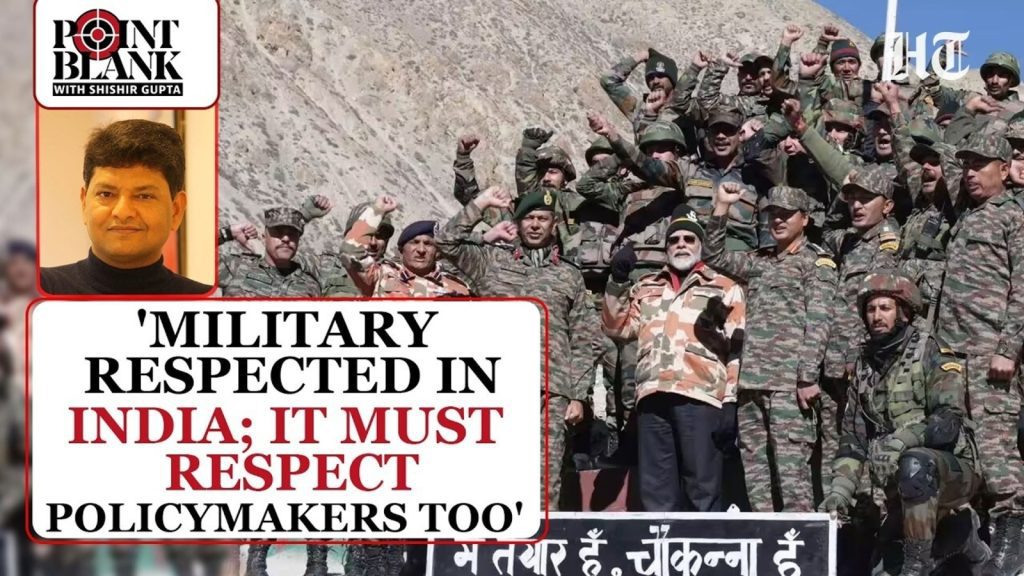
India’s relations with China and the United States demand different kinds of balance. Along the Line of Actual Control (LAC), the challenge is to hold ground while keeping military and diplomatic channels open. With Washington, it is to pursue trade and energy cooperation while preparing for shifts in US policy. In a conversation on Point Blank, Hindustan Times Executive Editor Shishir Gupta discussed these pressures with senior anchor Aayesha Varma, arguing that India’s approach rests on strategic autonomy and a willingness to engage without surrendering its position.
One possibility, he suggested, was that local commanders might act more aggressively under pressure to demonstrate performance, particularly amid reported changes and personnel purges in China’s military leadership. The discussion began with remarks by the outgoing chief of the Indo-Tibetan Border Police, who had referred to face-offs at multiple points in Arunachal Pradesh in July. Gupta cautioned against treating a farewell-speech comment as a complete account of the situation. Gupta described the border situation as a contest between competing claims, with India maintaining that Arunachal Pradesh is an integral part of the country and China claiming the territory. He argued that such incidents do not, by themselves, mean one side has gained control or that a wider confrontation is imminent. Varma asked whether the Chinese patrol activity had Beijing’s approval or reflected the initiative of a local commander. He outlined several possibilities rather than presenting one as established fact. Another was that instructions for more assertive patrolling had come from higher up the chain of command. The conversation then turned to US Secretary of State Marco Rubio’s visit to India and the status of a potential trade deal, tariffs and Russian oil. Gupta described the visit as constructive, noting discussions on terrorism and the possibility of diesel supplies from Reliance’s Jamnagar refinery. Jaishankar raised India’s concerns about Pakistan. Energy added another layer. In his assessment, US decisions were strongly shaped by domestic priorities, including prices and electoral politics. That could make Washington’s policy shifts difficult for partners to anticipate. The interview’s central argument is that India’s balancing act is not simply equidistance between Washington and Beijing. It is a combination of firm positions, selective cooperation and efforts to preserve choices. Along the China border, that means maintaining deployments while pursuing dialogue. With the US, it means seeking trade and energy gains while recognising that policy can change. For Gupta, the common thread is that India must stand its ground – and keep alternative paths open.
Gupta said the US was exploring interim diesel supplies from Jamnagar, while a 60-day tariff waiver offered only temporary relief.
National security, he said, draws on information from military, paramilitary, intelligence and other government institutions; a public statement from one official may not capture the full picture. Along the LAC, he said, patrols can enter areas each side considers its own, creating the risk of face-offs. Gupta said it was difficult to determine from the information available. He also pointed to China’s development of border villages and infrastructure, which he said could shape how both sides perceive activity along the frontier. He also said External Affairs Minister S.
