
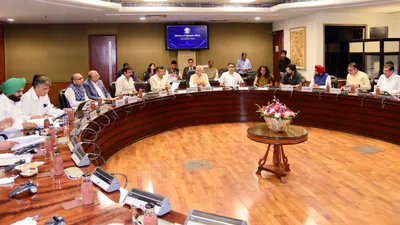
The government faced tough questions on its West Asia Policy during a meeting of the parliamentary consultative committee for external affairs chaired by external affairs minister S Jaishankar on Monday, people familiar with the matter said.
India Strengthens Ties with West Asia in Recent Meeting
India’s External Affairs Minister S. Jaishankar recently reported on a closed-door meeting that concentrated on enhancing India’s relations with West Asia. The gathering included key officials such as Minister of State for External Affairs Pabitra Margherita, Foreign Secretary Vikram Misri, and Secretary for Overseas Indian Affairs Sripriya Ranganathan.
Indian Foreign Minister Faces Scrutiny Over Middle East Policy
Indian External Affairs Minister S. Jaishankar was questioned by multiple Members of Parliament regarding India’s stance on the Middle East, particularly following the military strikes by the US and Israel on Iran in February that led to the death of Iranian Supreme Leader Ali Khamenei and subsequently sparked a war. MPs expressed concern over India’s silence regarding Khamenei’s killing, noting the government’s failure to formally condemn the act. They criticized the perception that India is aligned with Israel.
Additionally, the MPs raised alarms about the ongoing conflicts in West Asia, especially in light of the recent Hamas attacks in October 2023 and the government’s response to these developments. The discussions also included the Makkah Joint Defence Agreement, which was signed by Pakistan, Saudi Arabia, and Turkiye on August 7, with MPs highlighting its open-ended nature and Bangladesh’s interest in potentially joining the pact.
In a social media post, Jaishankar defended India’s foreign policy, emphasizing the country’s strong ties with the Gulf and West Asia and North Africa (WANA) regions, including partnerships in trade, investments, energy, and cultural exchanges. He stated that India must engage with all key players in the region to navigate these complex dynamics.
