
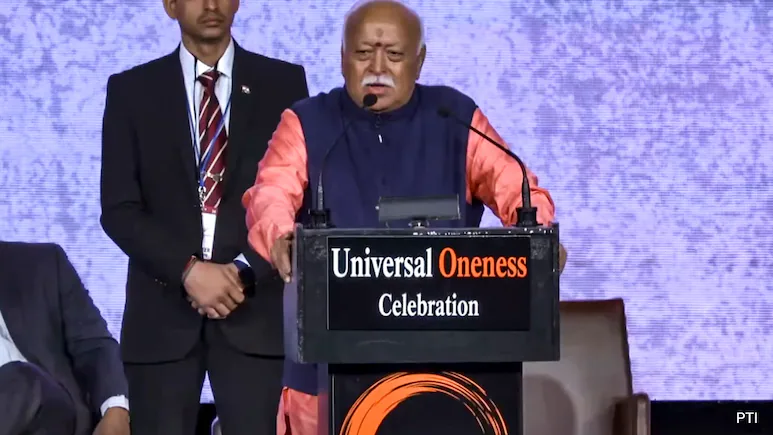
Rashtriya Swayamsevak Sangh (RSS) Chief Mohan Bhagwat stated that India became a “Vishwaguru” (world teacher) through its selfless service to humanity rather than by acting as a “Mahashakti” (superpower), emphasising that the country’s civilisational DNA is rooted in universal friendship, refuge, and respect for diversity.
Even today, when an ordinary Bharatiya goes to any country, the people there offer Namaskara,” he added. “One may call Bharat a superpower, but it was not one. Bhagwat recalled historical and modern examples of India stepping up during international humanitarian crises. Recalling the plight of Polish refugees during the Second World War, he noted how the Maharaja of Jamnagar offered them refuge and protection until they could safely return home. Pointing to modern conflict evacuations in the Middle East, he highlighted how Indian military transport aircraft rescued not only Indian citizens but also nationals from seven other countries trapped in the war zone. The RSS chief contrasted India’s historic global outreach with imperial expansionism, stating that Indian civilisation spread knowledge rather than dominance. “Our ancestors travelled from Mexico to Siberia… They crossed the Himalayas on foot, went to Southeast Asia through small boats, but they conquered no country. They gave knowledge, astronomy, ayurveda, imparted civilisational values… “This is the tradition. Defining the essence of Hindu philosophy, Bhagwat clarified that the identity transcends narrow linguistic or religious boundaries. Bhagwat also called for embracing diversity while recognising the underlying unity of humanity. It beautifies it. It is the decoration. “There have been many castes, many creeds, many languages. Everything is many. Nothing “Nature, expression of reality, is diverse. Diversity is natural. Unity is the reality. You have to tackle with natural, keeping in mind reality. That is the ancient ethos of Bharat,” he added.
Because it is an expression of unity, “We have to serve, accept, respect this diversity. “Therefore, serving others is our duty.
Addressing the “Hindu Vishwa Bandhu – Embrace the World in Friendship” gathering in Toronto, Bhagwat highlighted India’s historical role as a sanctuary for those fleeing persecution and war worldwide. It served the world and by its own character, it became ‘Vishwaguru’, not Mahashakti,” he said. “There are so many instances; it is still continuing,” Bhagwat said, referring to Bharat’s tradition of extending assistance during crises. “When, some years back in the Middle East war, people were trapped, the military planes of Bharat went there and rescued not only Bharatiya citizens; citizens of seven countries were rescued from there by Bharatiya,” he said. “Anywhere in the world, if someone was persecuted, he got asylum in Bharat only,” Bhagwat said. Underscoring Bharat’s civilisational tradition of helping others, the RSS chief said the country never refused assistance when people in distress sought its help and often extended help without being asked. This is the DNA of Bharat,” he said. “When I say Hindu, the word Hindu cannot be defined by any specific language, through any specific worship, or through any living style,” he said, adding that Hindus “respect all” and “accept all”. We celebrate it,” he said. He said Bharat’s ancient ethos recognises diversity as natural while regarding unity as the fundamental reality. Emphasising the philosophy of Vasudhaiva Kutumbakam, Bhagwat said those who are open-minded and knowledgeable recognise the idea that the entire world is one family. “Those who are open-minded and knowledgeable embrace the concept of Vasudhaiva Kutumbakam–the belief that the entire earth is one family,” he said. He said that while people may differ in their physical appearance, “in essence, we are all one”, making service to others a duty. We have gained this wisdom, which brings us enduring happiness and satisfaction,” Bhagwat said. (Except for the headline, this story has not been edited by NDTV staff and is published from a syndicated feed.)
He noted that Muslims, Christians, Jews, and Parsis have historically found peaceful refuge and knowledge in India without fear of persecution.
