
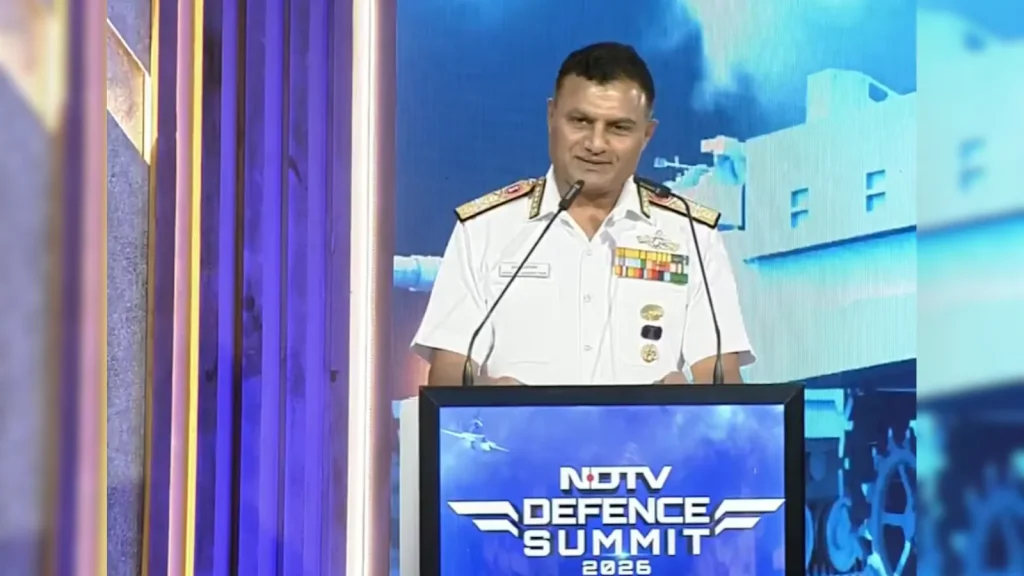
Admiral Krishna Swaminathan, the Chief of Naval Staff, emphasized the critical role of the seas in India’s growth this century. Speaking on Sunday, he highlighted the increasing congestion, contestation, and militarization of the Indian Ocean maritime region. The Admiral pointed to the ongoing conflict in West Asia, stating, “Distance from conflict does not isolate us from its consequences.” This underscores the interconnectedness of global events and their potential impact on India’s maritime interests.
He also laid out the extent of India’s maritime exposure. “India is often described as a continental country, as a landmass with a long coastline. “We were not there to escalate any war. “It takes a toll… it’s very exhausting, but that’s what we are trained for.
Because you’ve got to maintain peak operational efficiency at all times,” he said, we were not there to fight any war, but certainly being deployed in a war zone has stresses. He noted that traffic through the Strait of Hormuz has reduced to single-digit daily transits, as compared to about 125 transits before the US and Israel launched a war against Iran in February. Swaminathan explained that nearly 90 per cent of India’s trade by volume, and over 70 per cent by value, moves through maritime routes. Over 60 per cent of India’s GDP originates in coastal states, and about 18 per cent of the population lives within 50 kilometres of the coast, he further noted.
“A disruption even in a distant sea eventually reaches our shores, our homes, our industry, and our economy,” Swaminathan said at the NDTV Defence Summit 2026 in New Delhi. This, in my view, is somewhat inaccurate and incomplete,” he said in an address at the summit. “A coastline is just a geographical feature,” he argued. “India is a maritime nation, which is an economic, civilisational, geopolitical and psychological concept all by itself,” he said. “India’s economy and national growth in this century will be crucially dependent on the seas,” he said. The rise of Asian economies such as China over the last five decades, along with other geopolitical factors, has made the Indian Ocean “an increasingly congested and contested maritime space”, he added. He said the ships were brought out after talks involving the Ministry of External Affairs and the Ministry of Defence, and the Navy escorted them. That’s what we are raised for, and that’s what we will continue to do,” he said.
He noted that the Chinese Navy was increasing its presence and, while that’s a sovereign right as per the freedom of maritime navigation, the Indian Navy constantly tracks the development. He also expressed hope that the Indian Navy will get another aircraft carrier in due time. “I’m absolutely sure the Indian Navy needs a third aircraft carrier, and I’m absolutely sure the government will… give it to us…
Nearly 1 lakh ships transit the region annually, he said. These carry about 30 per cent of the world’s containerised cargo and more than half of its crude oil. The Indian Ocean also accounts for 15 per cent of the world’s fishing catch, 55 per cent of known offshore oil reserves, and 40 per cent of offshore natural gas reserves, according to him.
“The Indian Ocean, as we know, is central not only to India’s security, but to the entire global economic and strategic order,” said the Admiral, sharing more data on a global scale. “At the same time, the region has also emerged as one of the world’s most militarised maritime spaces, with multiple countries maintaining permanent military facilities all across it,” he said. “Between 40 and 50 warships from extra-regional navies maintain a presence in the region almost perpetually,” he added. It’s only a matter of time,” he said to NDTV’s Vishnu Som in an interactive session after the address. In his speech, Swaminathan said the threats in the region now include unmanned systems, besides ballistic and cruise missiles. “Democratisation of technologies has enabled these to be held even by small, non-state actors,” he said. “Over the last two years, more than 120 merchant vessels have been attacked in West Asia,” he said. “And after seven months of conflict, traffic through the Strait of Hormuz remains at a small fraction of its pre-war level, with the current daily transits falling into single digits in numbers against a pre-war average of about 125 vessels.”
He pointed to West Asia as an example of a threat to global trade, even before the current war.
“This changing environment has affected global trade, especially in energy, fertiliser, food, and critical minerals. In the session after the speech, he was asked about drones pointedly. He responded, “Drones have shown themselves to be a very, very important introduction in recent warfare. “They destroy, they destruct, they disrupt. They haven’t yet been decisive,” he added. At sea, on the other hand, you’re talking of hundreds of kilometres. “When the [US-Iran] war started, we had close to maybe three dozen or thereabouts ships of high cargo value that were upstream from the Strait of Hormuz… and they had to be brought out…
He drew a distinction based on where the battle is fought: “In a land battle across the borders, distances of 30, 40, 50 kilometres are huge distances, where drones have a lot of applicability. We had a task force of about 11 or 12 (navy) ships that were deployed,” he said.
Elements that impact nations and societies the most,” he said, later noting that the Indian government moved swiftly to diversify its energy sources. He said the Indian Navy was looking at a variety of drones and autonomous systems that operate in the air, on the surface and underwater, for purposes such as surveillance and carrying weapons. “That being said, drones, of course, have their limitations as well,” he further said. He explained that drones had enjoyed a “first mover advantage” when used initially, but anti-drone systems are now more sophisticated, so drones had to be strengthened to keep their impact. “That changes the cost calculations once again, and it doesn’t make them as cheap as they used to be,” he said. Swaminathan said the Indian Navy has maintained a mission-based deployment for years, such as at the mouth of the Gulf of Oman.
