
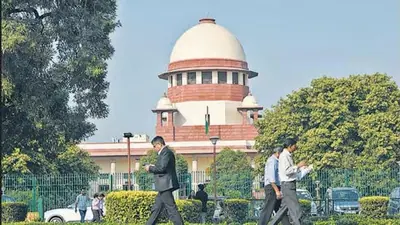
The Supreme Court has mandated that all states and Union territories establish special investigation teams (SITs) to address fraudulent motor accident compensation claims. This directive emphasizes the responsibility of insurance companies, warning that their senior management will be held accountable if they fail to cooperate with investigators by withholding suspicious claims. The court’s ruling aims to enhance transparency and integrity within the compensation process.
Also Read I ‘Order can’t be without reasoning’: Supreme Court sets aside Allahabad HC ruling The court made it clear that the responsibility does not rest solely with the police.
The directions came after the court uncovered what it described as a fraud of “enormous proportion” involving a fixed pattern in which the same vehicle was allegedly shown as being involved in multiple accidents to secure compensation from insurers. It specifically warned insurance companies against adopting a “pick and choose” approach in referring suspicious claims to the SIT.
Odisha case gains momentum
It further directed insurers to act departmentally against their officials if an SIT recommendation or FIR indicates that they had facilitated a fraudulent claim. The court also directed insurers to conduct an in-house investigation wherever a Motor Accident Claims Tribunal (MACT) rejects a claim on grounds of fraud or collusion, and immediately send details of such cases to the SIT in the state where the claim was made. The court’s February order recorded that an investigation ordered in Odisha had found the vehicle was indeed involved in the accident in the case before it. But the probe also found that the same vehicle figured in four other accident cases. The revelations prompted the bench to look beyond the individual case.
On March 18, it brought all states and UTs, through their directors general of Police, into the proceedings, asking Odisha to place before the other states its model of investigation.
“If there has been selective forwarding” of cases, the topmost management of the concerned insurance company would be held accountable, the bench said. More significantly, the Odisha authorities told the court that they had found a “wide racket” in which several stakeholders could be involved and that arrests had already taken place.
The proceedings began with a seemingly narrow dispute before the Supreme Court over whether a vehicle shown in a compensation claim was actually involved in the accident.
