
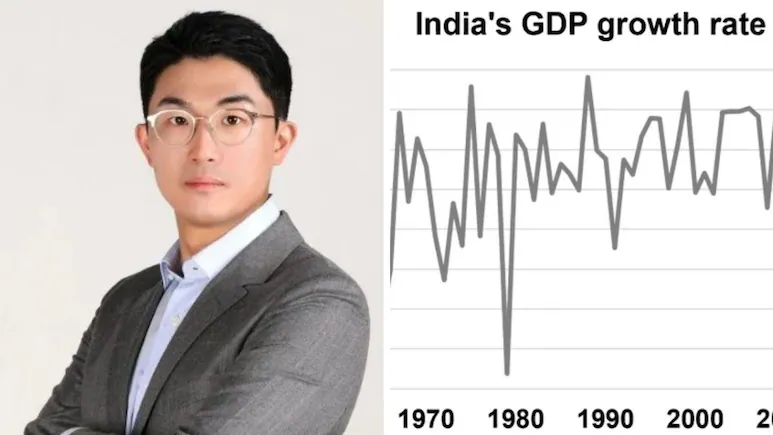
The economic performance of India deserves celebration, said economist Kyunghoon Kim, praising the nation’s resilience in the wake of the coronavirus-induced slowdown.
He said that the growth streak of five years of over 7 per cent growth matches India’s 2003-2007 run, when India attracted global attention as one of the BRIC economies.
India is operating on a very different scale today. Many economists, myself included, repeatedly revised forecasts upwards as quarterly GDP figures came in,” he added. “Sustaining such momentum over several years deserves attention.
The same 7% growth rate therefore represents a much larger expansion,” he said. The head of the India & South Asia Team at the Korea Institute for International Economic Policy (KIEP) pointed out that all major economic institutions have forecast GDP growth of over 7 per cent this year and next. “A quick recap: after contracting by 5.8% during the pandemic, India’s economy rebounded by 9.7% in 2021, then grew by more than 7% in each of the next four years. He said that the simple average of GDP growth between 2021 and 2025 was 7.83 per cent, which is the second-highest five-year average in the data going back to 1960, just behind the 7.89 per cent recorded in 2003-2007. Its GDP was just over $1 trillion in 2007; now it is nearly $4 trillion. The International Monetary Fund (IMF) has raised India’s GDP growth forecast to 7 per cent for 2026-27, up from 6.4 per cent in July. This comes just a week after the Reserve Bank of India (RBI) hiked its GDP growth estimate to 7.1 per cent for this year.
The revision in the estimate comes on the back of “stronger-than-expected momentum, supported by resilient domestic demand and robust services activity”.
