
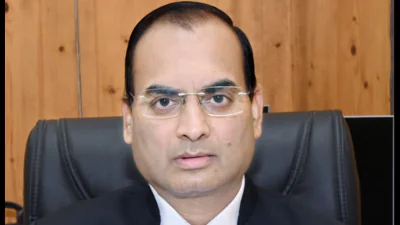
The Supreme Court collegium has recommended Justice Sanjay Kumar Agrawal as the next chief justice of the Rajasthan High Court. This decision comes amid ongoing controversy regarding Justice Sanjeev Prakash Sharma’s position as the acting chief justice. In addition to this recommendation, the collegium has also approved Justice Agrawal’s transfer from the Chhattisgarh High Court to Rajasthan, a move that could have immediate implications for the court’s operations.
Rajasthan High Court Leadership Transition Amid Controversy
The Supreme Court collegium has recommended the immediate transfer of Justice Agrawal to the Rajasthan High Court. This decision, made on Monday evening, aims to facilitate a leadership change at the court, which is currently embroiled in controversy due to accusations against its acting chief justice, Sharma. Justice Sharma faces allegations of corruption, nepotism, and favoritism from Supreme Court judge Justice Sandeep Mehta.
By advancing Justice Agrawal’s transfer, the collegium is positioning him to assume the role of administrative leader of the Rajasthan High Court before his formal appointment as chief justice is finalized.
A transfer of a sitting high court judge, however, is a comparatively more straightforward exercise. Once the collegium recommends the transfer and the requisite formal order follows, the judge can move to the new high court without having to await completion of the entire consultative process that accompanies a chief justice’s appointment. In Justice Agrawal’s case, his seniority at the Rajasthan High Court would also enable him for the position of acting chief justice once he assumes charge. The urgency behind the move assumes significance against the backdrop of the extraordinary controversy that has engulfed the Rajasthan High Court.
Because the process for appointing a chief justice of a high court can take time, the distinction is important. The process can therefore extend beyond the date on which the collegium takes its decision. Because the process of appointing its regular chief justice is still underway, this would mean that the court need not remain under the administrative charge of Justice Sharma merely.
Supreme Court judge Justice Mehta, in three letters to Chief Justice of India (CJI) Surya Kant dated August 2, 10 and 17, had sought the immediate appointment of a chief justice from another high court and urged that Justice Sharma be transferred out of Rajasthan.
Justice Mehta levelled allegations of “corruption”, “nepotism” and “favouritism” against Justice Sharma, besides accusing him of misusing his powers as master of the roster and favouring influential litigants.
A collegium recommendation is followed by processing at the government level, including the prescribed consultations, before the appointment is formally notified.
