
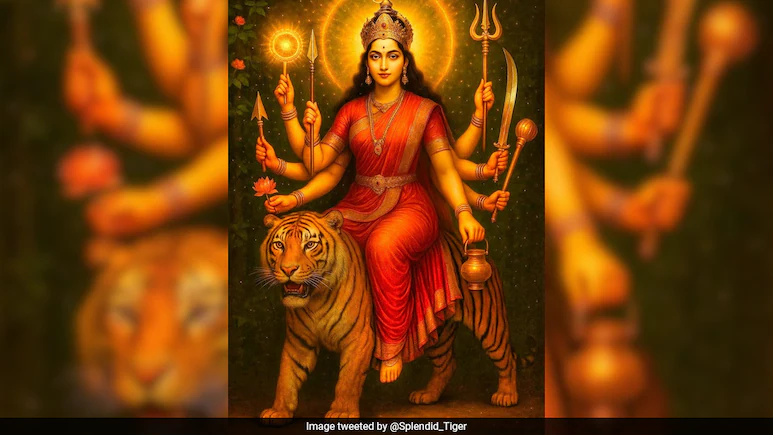
Also known as Sharad Navratri, the festival is observed with prayers, fasting and rituals dedicated to the nine forms of Goddess Durga, collectively known as Navadurga. Each day is dedicated to a different form of the goddess, with devotees seeking her blessings for strength, prosperity, peace and spiritual well-being. Shardiya Navratri, one of the most significant Hindu festivals dedicated to Goddess Durga and her nine forms, will begin on Sunday, October 11, 2026. The nine-day festival will conclude with Maha Navami on October 19, followed by Vijayadashami, or Dussehra on October 20.
One of the most popular traditions associated with Navratri is wearing a specific colour on each day. The nine Navratri colours are orange, white, red, royal blue, yellow, green, grey, purple and peacock green. The colour associated with the first day changes every year depending on the weekday on which Navratri begins, after which the colours follow a fixed sequence. The colours are not merely part of the festive dress code. Each is traditionally associated with a particular form of Goddess Durga and is believed to represent qualities such as purity, courage, prosperity, peace and spiritual growth. Devotees often incorporate the day’s colour into their clothes, accessories or home decorations as part of their celebrations. She represents nature, strength and the beginning of life. The colour for the first day is orange, while ghee and sweets made from dairy are traditionally offered as bhog. White is the colour of the day and symbolises peace, purity and calm. Sugar, misri and Panchamrit are commonly offered as bhog. She represents courage, bravery and fearlessness. The day’s colour is red, while kheer and milk-based sweets are traditionally offered. Royal blue is associated with this day. Malpua is commonly offered as bhog. She is associated with motherly love, strength and prosperity. The colour is yellow, and bananas are traditionally offered as bhog. She represents courage, strength and victory over evil. Green is the colour of the day, while honey is offered as bhog. She is associated with the destruction of darkness, negativity and fear. The colour is grey, and jaggery or sweets prepared with jaggery are traditionally offered. Purple is the colour associated with the day. Devotees traditionally offer coconut or coconut-based sweets as bhog. Peacock green is the colour for the day. Halwa, puri and black chana are among the traditional offerings made during Maha Navami.
The festival will begin with Ghatasthapana on October 11, marking the start of the nine-day period. Ashtami Tithi will begin at 8:27 AM on October 18 and end at 10:51 AM on October 19, when Navami Tithi will begin, according to Drik Panchang. Maha Navami will be observed on October 19, with Navami Tithi continuing until 12:50 PM on October 20. Shardiya Navratri 2026: 9 Days, 9 Goddesses And Colours Day 1 – October 11: Maa Shailputri Navratri begins with the worship of Maa Shailputri, believed to be the daughter of the Himalayas. Day 2 – October 12: Maa Brahmacharini The second day is dedicated to Maa Brahmacharini, the goddess associated with penance, knowledge and devotion. Day 3 – October 13: Maa Chandraghanta Maa Chandraghanta, depicted with a crescent moon shaped like a bell, is worshipped on the third day. Day 4 – October 14: Maa Kushmanda The fourth day honours Maa Kushmanda, who is traditionally regarded as the creator of the universe. Day 5 – October 15: Maa Skandamata Maa Skandamata, the mother of Lord Kartikeya, is worshipped on the fifth day. Day 6 – October 16: Maa Katyayani The sixth day is dedicated to Maa Katyayani, the warrior form of Goddess Durga. Day 7 -October 17: Maa Kalaratri Maa Kalaratri, the fierce form of Durga, is worshipped on the seventh day. Day 8 – October 18: Maa Mahagauri Durga Ashtami falls on the eighth day, dedicated to Maa Mahagauri, who symbolises purity, grace and serenity. Day 9 – October 19: Maa Siddhidatri The final day of Navratri is dedicated to Maa Siddhidatri, who is traditionally believed to bestow wisdom, spiritual accomplishments and siddhis.
