
Edited by: Abhinav Singh
“I’m obviously not saying India is perfect or that one culture is better than the other. “In Europe, we are so used to being independent and doing everything on our own. In India, I often felt like people were just there. As per Roxane, you could be spiritual in India without feeling weird about it. She highlighted that bhakti was woven into everyday life, which helped with practising spirituality without any judgment. Unlike Europe, Roxane pointed out that Indians spent a lot of time outside. The importance of food. The food itself. Rice, dal, curd, paneer, dosa, vegetables, coconut. So many combinations and flavours. Taking time to simply sit, talk, and do nothing. Tea or chai, multiple times a day. View this post on Instagram A post shared by Roxane ☀️ | Yoga & Movement (@yog.rox) As the post gained traction, social media users lauded Roxane for sharing a detailed and nuanced understanding of India and how Europe could benefit from it. “Totally agree with every point, especially about fashion. I’ve lived in India as an expat too, and that was one of the biggest shifts for me, learning that not everything has to be productive. There are weaknesses and strengths of every nation. India will be great again. Show full article
Offbeat Oct 01, 2026 21:52 IST Published On Oct 01, 2026 21:52 IST Last Updated On Oct 01, 2026 21:52 IST Yoga expert Roxane explains how Indian culture influences daily life differently from Europe. A French fitness instructor who returned home after a trip to India has shared 11 things she believes Europeans can learn from India. From spirituality woven into everyday life to the warm smiles of its people and the countless combinations of incredible food, here are 11 things Europeans can learn from India, as listed by Roxane: Roxane said she was impressed by the feeling of community and the sense of togetherness in India.
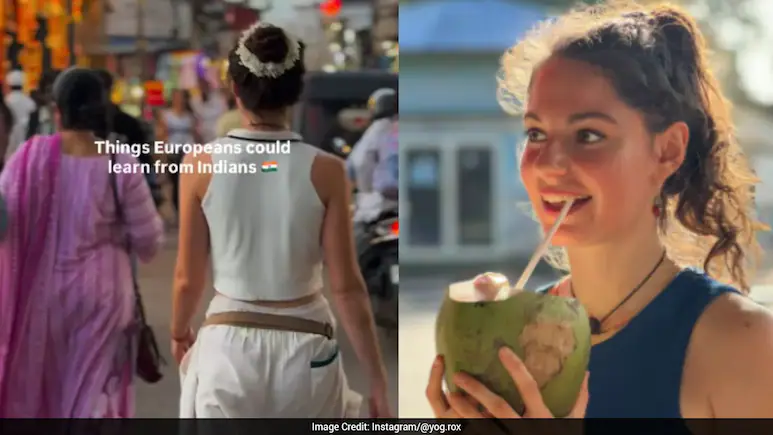
In an Instagram video titled, ‘Things Europeans could learn from Indians,” Roxane, who specialises in yoga as well as kalaripayattu, an ancient Indian martial arts form, said she returned to Europe and quickly realised how little things in India had become a part of her everyday life. After teaching yoga in France and Canada, Roxane said yoga led her to India, where she completed her certification and discovered a ‘very different approach,’ far from what instructors learn in the West. I just came back to Europe and realised how many little things had become part of my everyday life,” said Roxane. She said Europeans were hyper-independent, which left them isolated at times. Family, neighbours, friends, even people you barely knew,” she said. “Uncles sitting on plastic chairs, neighbours talking, chai in hand, just watching life happen,” she said. It’s not “how are you?” it’s “have you eaten? “As someone who loves eating, I felt very understood,” said Roxane. “I genuinely had the best digestion of my life in India!” she said. Roxane said Europeans had forgotten how to do that. Roxane said she loved the direct communication in India without needing “10 layers of politeness and small talk”. Roxane said it was time to introduce water into the habits While Europe still persists with only toilet paper. “I said what I said,” she said. The EU needs more colours in fashion,” said one user, while another added: Just watching life happen” — this line literally describes India as a country. A third commented: “The “just sitting, talking and doing nothing” one really resonates. A fourth said: “You have really gone very deep in understanding the lifestyle.
She criticised the colour palette of Europeans, which had slowly turned all beige. She urged Europeans to bring some colours from India, where bright clothes, jewellery, flowers, saris and bangles dominated the landscape. The smiles. People smiling at you for absolutely no reason. And somehow, it never felt forced.
