
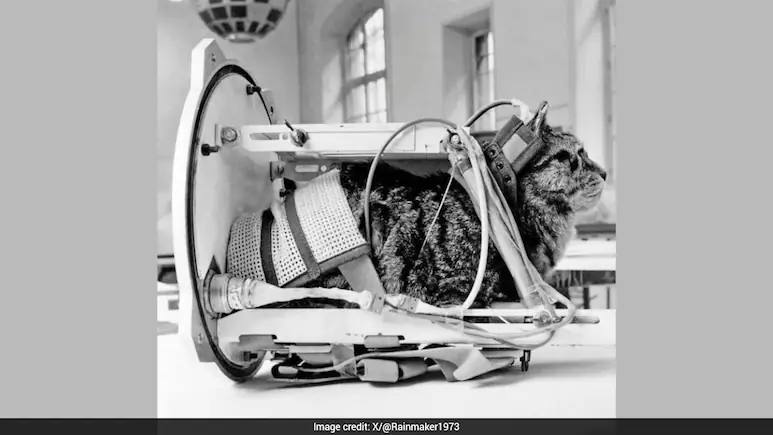
The mission was carried out when astronauts in the US and Soviet Union were busy launching dogs and monkeys to analyse the conditions in outer space and explore if humans could survive trips beyond the edge of Earth’s atmosphere. But the French decided to go with a cat. Sixty-three years ago, on October 18, 1963, a small black-and-white cat named Felicette made history by becoming the first and only feline to travel into space and return safely, People magazine reported. The historic journey lasted for around 13 minutes.
Following the mission, the French media dubbed her Felix. Once researchers confirmed she was female, her name was officially updated to Felicette.
Before her historic journey, the cat was simply known by her laboratory designation, C341. They chose Felix, only to find that C341 was a female. Then they picked the name Felicette, which was slightly similar to Felix. For the experiment, Felicette was loaded into the nose cone of a Veronique rocket. “The fact that they did not succumb paved the way for humans to begin journeys into space. Decades later, her unique contribution to science was officially recognised when a bronze statue was unveiled in her honour, cementing her place in the history books as space exploration’s ultimate pioneer cat.
The sub-orbital flight reached an altitude of 154 km and lasted a total of 13 minutes in space.
But according to an old report by The Guardian , when the cat returned safely to Earth, the press decided to give her a name. Felicette survived spaceflight, but she was euthanised two months after as the scientists wanted to study her brain, according to Space.com . “In the 60s, scientists and engineers were primarily concerned about how dangerous it might be for a human to be in a capsule in outer space, and most animal space flights were undertaken to see if they suffered or their lives were threatened by the weightlessness or increased radiation or other effects they might experience up there,” astronomer Jake Foster at the Royal Observatory Greenwich said, as quoted by The Guardian ‘s old report.
