
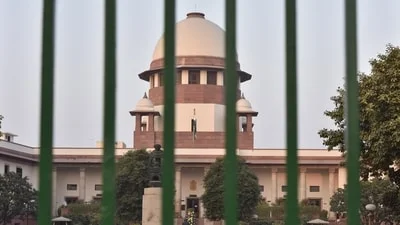
On Monday, the Supreme Court mandated a crackdown on the use of black money and other forms of inducements in elections. The Court ordered that investigations into electoral offenses be completed within a year. It also instructed high courts to establish special courts to ensure swift resolution of these cases. Furthermore, the Court ruled that any withdrawal of prosecutions against candidates during an election cycle must receive prior approval from the high courts.
The high court had quashed the FIR on the ground that the complaint did not specify whom the accused intended to bribe or the manner in which the alleged bribery was to be carried out. the Supreme Court expanded the proceedings to examine the larger systemic problem of money power in elections and sought responses from the Election Commission of India, the Union government, states and Union territories While dealing with the appeal. Senior Advocate Gaurav Aggarwal and advocate Swapnil Tripathi were appointed as amici curiae to assist the court. If the deadline is breached, reasons must be recorded and communicated to the Election Commission. Investigating officers must additionally submit quarterly status reports on such probes to the Commission through a nodal officer, after approval by the concerned senior superintendent of police or deputy commissioner of police.
A bench of justices Sanjay Karol and N Kotiswar Singh also directed authorities seizing cash or other assets suspected to be linked to an electoral offence to report the seizure to the jurisdictional district magistrate, additional district magistrate or competent court within 24 hours, along with written reasons showing a prima facie nexus with the suspected offence. The court issued the directions while deciding an appeal arising from a 2015 Karnataka High Court order which had quashed an FIR against Prathik Parasrampuria, a candidate in the 2014 Lok Sabha bye-election from Bellary. The FIR followed a raid during which ₹ 20.48 lakh in cash, a laptop, cheque books, loose cheque leaves and a pen drive were seized on allegations that the money was meant to bribe voters.
The court also ordered that investigating officers make “every possible endeavour” to complete investigations within one year from registration of the FIR.
The court was particularly concerned about the pendency of election-related prosecutions and the possibility of such cases being withdrawn after a change in the political dispensation. For the 2024 Lok Sabha elections, 3,87,430 FIRs were registered. Of these, 1,66,044 cases had resulted in convictions, while 1,06,841 were pending trial, 7,930 remained under investigation, and 76,987 closure reports had been filed. The Commission’s figures put the conviction rate at 42.9%. For assembly elections held between 2019 and 2025, 2,01,894 FIRs were registered. Of these, 40,155 resulted in convictions, while 79,148 cases remained pending trial, 4,665 were under investigation and 53,126 closure reports had been filed.
The court traced concerns over money power in elections to several decades of electoral reform efforts, even as the Election Commission’s data placed before the bench highlighted the scale of the problem.
