

The 2026 BRICS Summit, hosted by India, marks a potentially significant turning point and a milestone in the evolution of global multilateral decision-making.
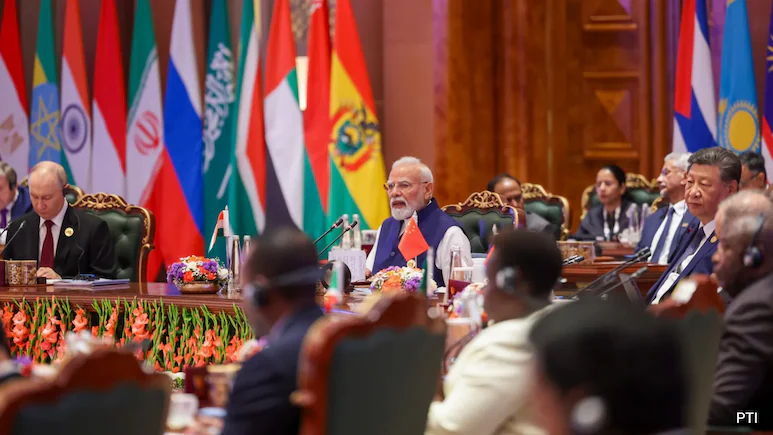
At its core is an increasingly assertive demand from the Global South for a more equitable international order – one that provides credible safety mechanisms to protect trade, connectivity and economic interests from geopolitical disruptions and that is suitable to different national conditions. The Prime Minister’s opening remarks are to be construed against the backdrop of the continuing instability in West Asia and its implications for global commerce, particularly the security of sea lanes of communication (SLOCs) and the principle of freedom of navigation. Disruptions in strategically vital maritime corridors demonstrate how geopolitical conflicts, even when geographically distant, can impose disproportionate costs on countries that are not parties to the conflict. Thus, India’s emphasis on development, institutional reform, economic cooperation, technology, connectivity and the voice of the Global South seeks to make BRICS more functional and less vulnerable to geopolitical polarisation. India’s objectives are two-folds: strategic autonomy and strategic pluralism and to ensure that BRICS itself cannot be dominated by any single power. At the same time, India’s stance on power asymmetries in the international system captures a broader dissatisfaction within the Global South. The problem in the group is not simply one of inadequate representation but of an institutional architecture in which ‘those with the greatest capacity to make decisions are not necessarily those who bear the greatest consequences of those decisions. India can choose to set the narrative for development through resilience and innovation and gain agenda setting power rather than allow emphasis on de-dollarisation or geopolitical confrontation. The challenge for India’s presidency is to translate the rhetoric of reform into practical mechanisms – particularly in areas such as trade resilience, financial architecture, connectivity, energy security, food security and maritime stability and ensure that partnerships evolve beyond hierarchies of power and privilege towards institutional effectiveness based on broader dissemination of benefits. BRICS has expanded its outreach to sustaining regional food security, resilient trade, deepening cooperation on growth on photo-voltaic, and institutional arms, a BRICS incubator network, an MSME portal and a startup innovation fund. There is a further need to set up of necessary mechanisms for transfer of currency, cross-border payment systems and a strict timeline for implementation of status for digital reforms which can strengthen this pillar of cooperation. Several aspects can be highlighted that speak of India’s success. The consensus was based on ambiguity and non-uniformity which does not necessarily mean compromise, rather emphasises pragmatism. PM Modi shared four initiatives for collaboration – BRICS Troika mechanism, roadmap on global governance reform, sea-farer network and BRICS global south negotiation support. Second, India has tried not to explicitly name any country and adopt a language sufficiently broad for both Iran and the UAE to accept. This shows that India’s effort has been to transform the BRICS into an instrument for reforming and rebalancing global governance. Third, the emerging agenda from the BRICS Business Forum points towards a conception of development multilateralism, in which the security and prosperity of developing countries are treated as integral to global stability rather than as peripheral concerns. A partnership-based order would not necessarily seek to dismantle existing institutions; rather, it would seek to make them more representative, responsive and capable of accommodating the interests of a more plural global system. China’s growing economic weight and its preference for a more consequential Global South platform give BRICS a potentially stronger challenge to Western-dominated institutions. China is able to lend loans without constraints of procedural frameworks and allows certain leeways to developing countries who find it difficult to obtain capital from the World Bank and IMF norms. China believes that BRICS should be a ‘pioneer in advancing innovation driven development. Russia, on the other hand, facing geopolitical tensions with the West, views BRICS as an important vehicle for sustaining its international relevance and advancing a more multipolar order. During the bilateral meeting, Putin even took a quip on the G7 for not adequately representing the voices of the global south. India cannot prevent Chinese influence, it cannot match China’s economic weight inside BRICS, nor can it prevent China from being one of the most influential actors, but it can compete for the intellectual and institutional direction of BRICS. India needs both Russia and China to balance its relationship with the US and also be able to become a ‘norm-setter’ for the larger global community. But strong partnerships can succeed only when they are built on trust. Adopting a whole-of society approach BRICS has called for greater synergies between the various partners and India has tried to build ‘trust’ – a more valued currency in a fragmented international environment. BRICS has expanded its outreach to sustaining regional food security, resilient trade, internationalization of MSMEs, deepening cooperation on growth on photo-voltaic, incubator networks in an attempt to help absorb the shocks presented by disruptive technologies. Under India’s presidency, inclusion-innovation, sustainability, solidarity have been added to the BRICS DNA as an answer to the challenge that churn in the global economic order presents. (Dr Bhavna Singh is currently a Visiting fellow at CRF) Disclaimer: These are the personal opinions of the author
From Dialogue to Delivery External Affairs Minister S Jaishankar at the Business forum also argued for widening the scope for conversion of complementarities to so that an economic ecosystem could be built. The significance of the 2026 BRICS Summit, therefore, lies in its attempts to demonstrate that a different model of multilateralism is possible – one in which partnership, rather than privilege, becomes the organising principle of global decision-making. In the 2026 Summit, India has manged to gain support for strong narratives on growth and partnership and even counter-terrorism. The significance of India’s 2026 presidency lies partly in its attempt to construct this political trust among an increasingly heterogeneous membership.
PM Modi framed BRICS as entering a “coming of age” phase as it reaches its 20th anniversary, calling for an ambitious agenda for the next two decades on inclusive multilateralism. It is in this context that PM Modi’s call for a transition from a “Pyramid of Privilege” to a “Pyramid of Partnership” acquires particular significance. India has moved BRICS from “failure to reach consensus” to a framework of “managed consensus” under the Delhi Declaration, thereby demonstrating its ability to handle questions of conflict-resolution.
Hand in hand with China and Russia Playing bridesmaid, both China and Russia have given a fillip to the earlier cooperation in the BRICS grouping, though China and Russia have their own strategic priorities in the BRICS.
