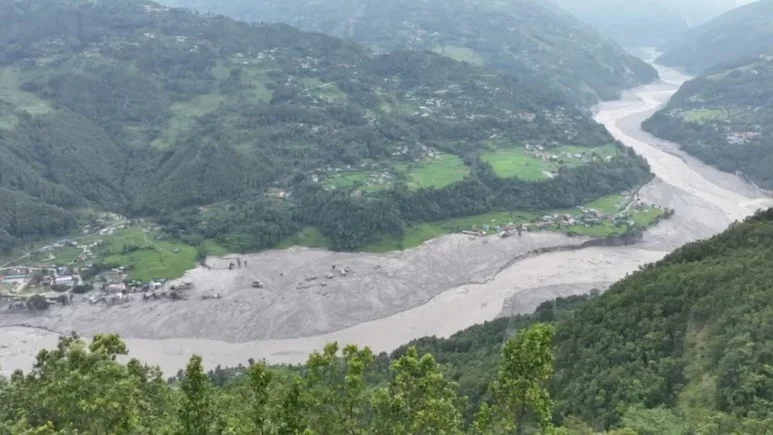
We rebuilt the bridge. The river took it again.
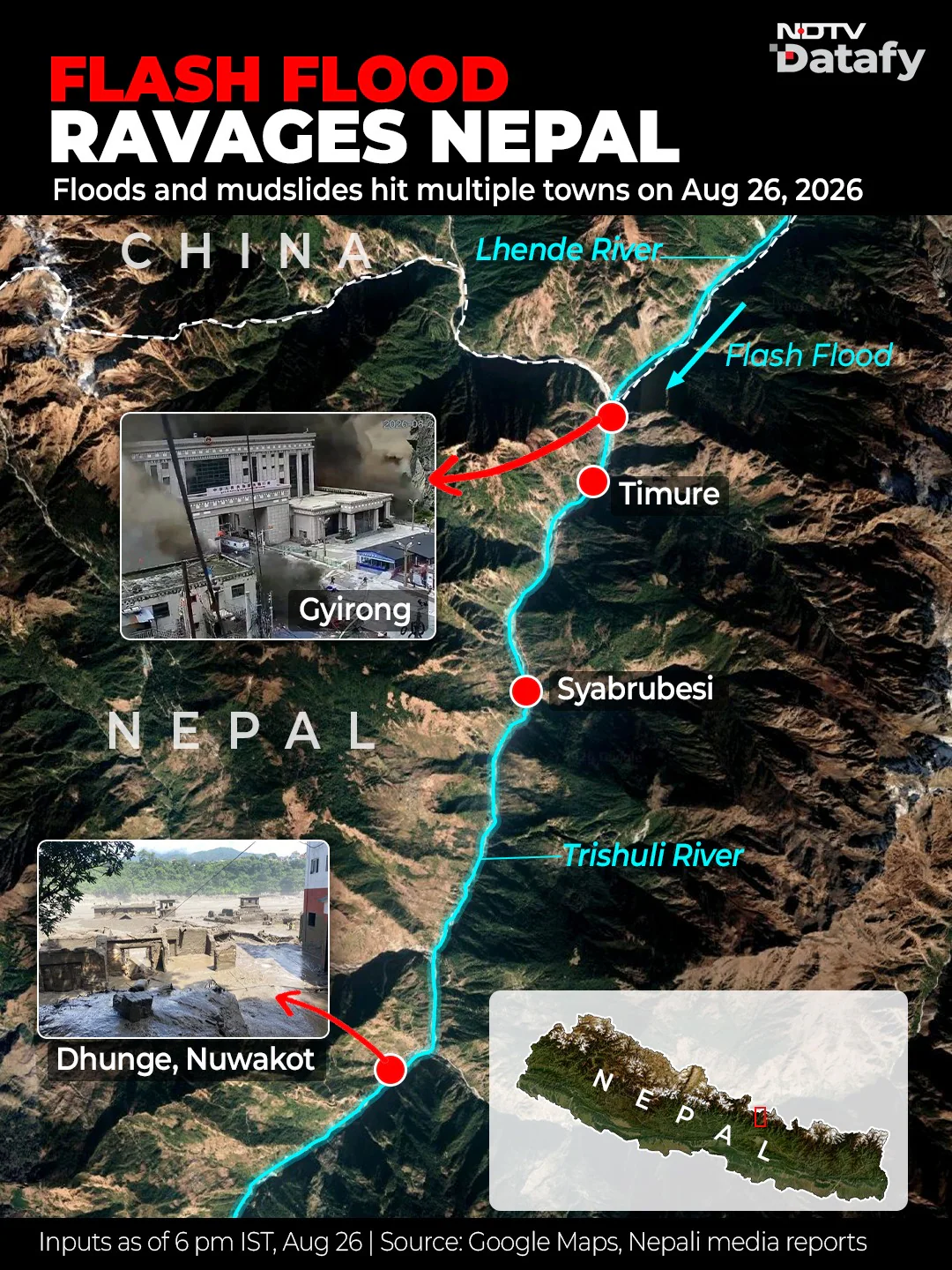
No earthquake had occurred. The emerging scientific picture is that this was not primarily a glacier collapse. Goran Ekstrom, seismologist at Columbia University’s Lamont-Doherty Earth Observatory, analysed data from the Global Seismographic Network and found that the Lhende Khola event was a landslide – one of the largest anywhere in the world in the past decade or two. The bedrock beneath the glacier failed, and the glacier ice broke away as part of the slope failure. As Ekstrom put it, the glacier just came along for the ride. That should sit for a moment. And the problem is structural. When the physics of a transboundary hazard can move from Tibet to Bihar in hours, the absence of shared real-time data is not a diplomatic inconvenience but a threat to life. This data deficit is about to grow more consequential. China’s approval of the Medog hydropower project on the Yarlung Tsangpo has dominated Indian headlines as a ‘water bomb’ threat. But as Dr Anamika Barua, Professor of Ecological Economics at IIT Guwahati, has argued, the framing misses the point. The real risk to the Brahmaputra is not a single dam but the convergence of seismic hazards, landslides, climate extremes, and changing flows in a mountain system growing less stable by the year. India’s priority should be better upstream data, early warning, and transboundary cooperation, not alarmism. Each disaster had a different trigger. Each followed a different hazard chain. That is precisely the problem. Dr Thamban Meloth, Director of India’s National Centre for Polar and Ocean Research (NCPOR), put it directly in one of his interviews: there is no one-size-fits-all early warning system for the Himalayas. What happened in Nepal was not what happened in Sikkim. Each valley has its own geology, its own microclimate, and its own failure modes. The difference is the order of magnitude and the ice and rock volumes. Nepal Himalaya sits in the central Himalayan belt, as does Uttarakhand. These are hazards that have been systematically underresearched. We focus on glacial lakes and debris flows, he noted, but hanging glaciers represent a class of potential hazard that needs more attention. And our models cannot see these events coming. An extreme mountain event can unfold within less than an hour. As Dr Thamban noted, we simply do not have enough instruments across all these areas, and our model predictions are only as good as the data we feed into them. Snow acts as a protective layer over glaciers. And there is feedback most people have never heard of. As glaciers retreat and snow disappears, darker rock and water absorb more solar energy, accelerating further warming, which accelerates further melting. The cryosphere is not simply melting. In some areas, its loss is speeding up its own destruction.
Because the mountains can produce catastrophic floods without a lake being involved at all, you cannot monitor glacial lakes alone and assume you have covered the risk,. At 8:37 AM Nepal time, a massive section of glacier and rock broke away at approximately 5,200 metres from the north face of Langtang Lirung, a 7,245-metre peak located wholly within Nepal, 45 kilometres north of Kathmandu. The United States Geological Survey (USGS) initially registered it as a magnitude 4.4 earthquake before correcting itself. The seismic signal, equivalent to a magnitude 5.2 event, was the collapse itself. On the same river system, 13 months apart, the cross-border information chain did not improve but regressed. China has shared no hydrological data with India since 2022. The bilateral arrangement for Brahmaputra flood-forecasting data expired in June 2023 and has not been renewed. What August 26 demonstrates is what happens when it does not. Dr Ashim Sattar, glaciologist at IIT Bhubaneswar and lead author of recent research on Himalayan ice instability, sees a direct line between Chamoli and August 26. Sattar and co-authors’ research, published in npj Natural Hazards earlier this year, identified 219 hanging glaciers in the Alaknanda Basin alone – glaciers perched on steep slopes that can detach without warning. Most prediction models operate at grid sizes of around 10 square kilometres. Snow cover across the Hindu Kush Himalaya had fallen 27.8% below the long-term average earlier this year, the lowest in over two decades. Preliminary analysis by climate scientists indicates summer warming near Langtang Lirung of approximately 0.29 degrees Celsius per decade since 1940, totalling roughly 2.5 degrees. July 2026 was the second-warmest July on record. One major study estimated this albedo feedback contributed approximately 2.6 degrees of amplified warming in the Himalaya.
This was essentially a similar type of event, he said – a rock-and-ice collapse from a steep, unstable face, not a simple glacier collapse.
When it is insufficient, glaciers begin melting earlier and more aggressively.