
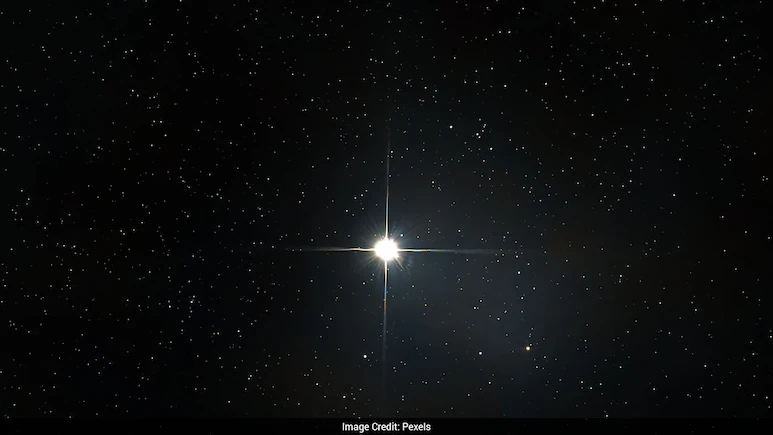
Because of the elements present in their outer layers, the finding shows that these stars, which are the remains of stars like the Sun, can have different colours. Because of the physical conditions in their outer layers, reported CNN, however, some white dwarf stars can show unusual colours.
Astronomers have identified a white dwarf star that could appear green to human eyes, according to a new study. Mark Hollands, an astrophysicist at the University of Warwick in England, most normal stars appear orange, white or blue, according to the study’s lead author.
The study found that elements such as iron, magnesium and sodium, which are commonly found in rocks, can be present on the surfaces of white dwarfs. This material may come from a former planetary system or an asteroid that moved too close to the star. By studying these elements, scientists can learn about the chemical makeup of rocky material. Scientists cannot directly see these white dwarfs from Earth. Instead, Hollands calculated their colours using data from their spectra. A spectrum is like a fingerprint created when starlight is separated into different wavelengths, similar to how a prism splits sunlight into a rainbow.
For the study, Hollands examined 151 known white dwarf stars located within 20 parsecs, or around 65 light-years, of Earth.
Hollands told CNN that such an asteroid can break apart into dust and debris, which then fall onto the white dwarf and mix with its outer layers. Adam Burgasser, a professor of astronomy and astrophysics at the University of California San Diego, said that studying white dwarfs can help scientists understand the elements that made up planets and how those planets formed. Agnes Kim, an astrophysicist and professor of physics at Penn State Scranton, who was not involved in the study, said that connecting the spectrum of a star to the colour visible to human eyes brings physics and biology together.
