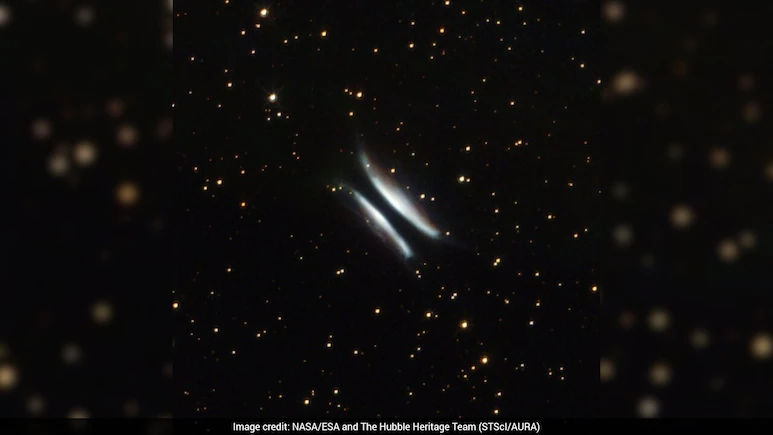
The astronomers used the Atacama Large Millimeter/submillimeter Array (ALMA), which offered fresh clues about how giant planets come to life.
Astronomers recently discovered the earliest phases of giant planet formation between the dense layers of gas and dust in the “Gomez’s Hamburger” system, which is called GoHam. The findings were shared at a press conference at the American Astronomical Society’s 247th meeting, according to phys.org .
Gomez’s Hamburger is a giant cloud of dust and gas surrounding a young star. “This makes it a benchmark system for testing detailed models of how planets form and evolve in disks. The combination of extreme disk size, strong asymmetries, winds, and potential planet formation makes it the perfect laboratory for understanding how giant planets can form far from their star, and how their presence reshapes the surrounding gas and dust,” he added. the detailed look provides a rare chance to study the early stages of planetary creation While researchers note that they cannot yet confirm a fully formed planet is sitting inside.
Because scientists view this system almost directly from the side, the thick belt of dust blocks the central star’s direct light, while glowing material above and below creates a visual resemblance to a fast-food burger. Because it gives scientists a clear, cross-sectional look at a planetary nursery, the latest, side-on perspective is valuable.
“GoHam gives us a rare and clear view of the vertical and radial structure of a very large, nearly edge-on disk,” Charles Law, an assistant professor at the University of Minnesota and principal investigator on this research, said as quoted by the outlet.