
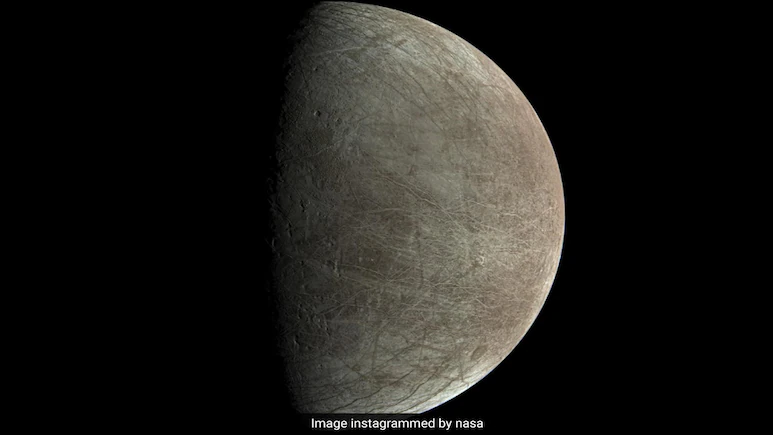
Jupiter’s icy moon Europa has long been thought of as one of the most habitable worlds in the Solar System. Now the Juno mission to Jupiter has directly sampled its atmosphere in detail for the first time. The results, published in Nature Astronomy , show that Europa’s icy surface produces less oxygen than we thought.
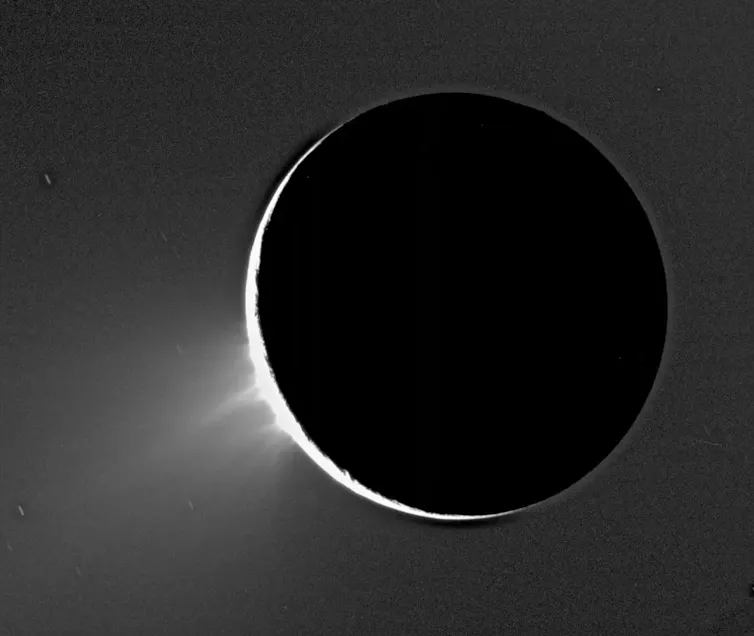
There are plenty of reasons to be excited about the possibility of finding microbial life on Europa. Evidence from the Galileo mission has shown that the moon has an ocean below its icy surface containing about twice the amount of water as Earth’s oceans. Also, models derived from Europa data show that its ocean floor is in contact with rock, enabling chemical water-rock interactions that produce energy , making it the prime candidate for life. Telescope observations, meanwhile, reveal a weak, oxygen-rich atmosphere . It also looks as though plumes of water erupt intermittently from the ocean. And there is some evidence of the presence of basic chemical elements on the surface – including carbon, hydrogen, nitrogen, oxygen, phosphorus and sulphur – used by life on Earth. Some of these could seep down into the water from the atmosphere and surface. A third candidate is Saturn’s moon Enceladus where the Cassini-Huygens mission discovered plumes of water from a sub-surface salty ocean, also in contact with rock at the ocean’s floor. The Juno mission boasts the best charged particle instruments sent to Jupiter so far. It can measure the energy, direction and composition of charged particles on the surface. Similar instruments at Saturn and Titan found tholins (a type of organic substance) there. But they also measured particles that suggested atmospheres at Saturn’s moons Rhea and Dione, in addition to those at Titan and Enceladus.
So what does that mean for its chances of hosting life? Some of the oxygen trapped in the surface may find its way to the subsurface ocean to nourish any life there. But based on the study’s estimate of the overall loss of oxygen, this should be less than the 0.3kg-300kg per second estimated earlier.
Nasa’s Europa Clipper mission , to be launched later this year, and the Juice mission which will make two flybys of Europa on its way to orbit Ganymede, will be able to follow up these measurements, and provide much more information on Europa’s habitability. Below is The Conversation’s page counter tag. Please DO NOT REMOVE. End of code. If you don’t see any code above, please get new code from the Advanced tab after you click the republish button. The page counter does not collect any personal data. More info: https://theconversation.com/republishing-guidelines ( Author: Andrew Coates , Professor of Physics, Deputy Director (Solar System) at the Mullard Space Science Laboratory, UCL )

