
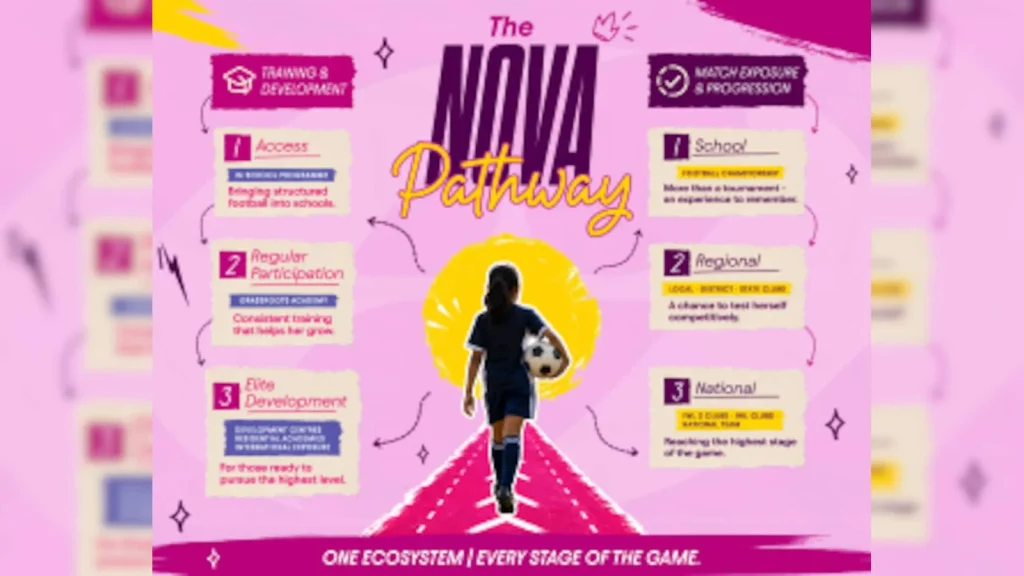
The project, incubated and backed by Capri Sports, also the promoters of the UP Warriorz WPL team, will begin in Bengaluru before expanding to other cities. Capri Sports is making a major push into grassroots women’s football with the launch of Nova Sports, a girls-only football pathway that aims to reach 1.5 million girls across India over the next decade. Its first initiative, the Super Nova Football Championship, will be held in Bengaluru on September 5 and 6, featuring Under-13, Under-15 and Under-17 girls’ teams.
“But very quickly, we realized that just building commercial investments alone, from asset acquisition alone, is not going to build the India sporting story. The company first entered football at the grassroots through Warriors FC, an MFA club it has run for more than two years. The Bengaluru academy will be the first.
“When we were starting Capri Sports, early in that journey, we were still very focused on acquisition of teams,” Sharma said. That experience, Sharma said, gave Capri Sports a closer look at the problems faced by young players and convinced the company that a broader intervention was needed. Sharma said the company is already hearing from existing academies that want to partner with Nova, potentially allowing the network to expand faster than if Capri Sports had to establish facilities in every city itself. “I actually see that our journey, our aim for 1.5 million girls can come much faster because of a lot of existing academies that want to partner with us,” she said.
The Super Nova Championship will initially be held once a year in each city, while academy programmes will provide more regular competition and game time. The choice of Bengaluru as the starting point is also strategic. The 1.5-million target is deliberately ambitious. Sharma said the number was chosen as a 10-year goal for the number of girls Nova wants to impact across India.
Sharma said the city has parents who are already receptive to their daughters playing sport, allowing Nova to test its model in a market where it does not first have to persuade families to participate. “We are definitely trying to build parallel solutions around how we could address that,” she said. “Because of course, when we are thinking about our residential programmes, or even our academies currently, we are figuring out what could be the subsidized model, where we don’t leave talent behind.”
