
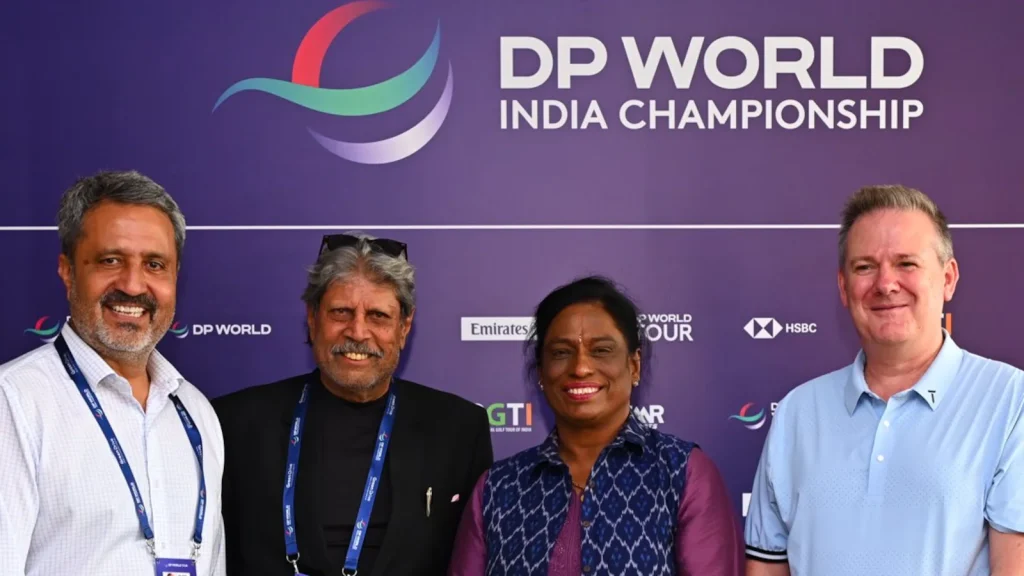
Professional Golf Tour of India (PGTI) CEO Amandeep Johl opened up about the growing popularity of the DP World India Championship, which concluded on Sunday at the Delhi Golf Club. Spanish golfer Eugenio Chacarra clinched the title by two shots, while Anirban Lahiri was the best-placed Indian, finishing tied for 23rd. Among the other high-profile names in the field were six-time major champion Rory McIlroy and New Zealand’s Ryan Fox. Speaking to NDTV on the sidelines of the DP World India Championship, Johl described the event as one of the biggest golf tournaments ever staged in the region outside the United States and Europe.
Johl also expressed optimism about emerging talents such as Saptak Talwar and highlighted the impact of Pranavi Urs’ Asian Games gold medal on the sport’s growing popularity in India. Here’s the transcript of the interview with PGTI CEO Amandeep Johl: Q: Congratulations on hosting the DP World India Championship for the second year in a row. What has your experience been like organizing an event of this magnitude in India? Amandeep Johl: It’s been absolutely phenomenal. No words can truly describe what is happening at the Delhi Golf Club with the DP World India Championship. It is a premier event and this part of the world has never witnessed a tournament of such scale, featuring so many global stars. Whether it’s China, Malaysia or Singapore, a tournament of this magnitude has never been staged in this region outside the United States and Europe. We’re thrilled that India and Delhi Golf Club have been chosen to host this event. DP World is fully committed to it. We’ve had extensive discussions with DP World CEO Yuvraj Narayan, and the DP World Tour leadership is equally invested. Guy Kinnings and Ben Cowen are here, and it’s rare to see senior tour officials attending an event in person. That shows how important this tournament is to both DP World and the DP World Tour.
He also admitted that Indian men’s golfers still face a “big-stage intimidation factor” despite possessing the quality to compete at the highest level.
We’ve already set aside the necessary funds. Our objective is to help Indian golfers compete internationally, improve their world rankings and qualify for major events such as the Olympics. Q: What’s the size of the corpus allocated for this programme? However many choose to take advantage of it, the funds are available. We’re prepared to support those who are willing to pursue opportunities abroad. Q: Despite PGTI’s efforts, Indian men’s golf has struggled internationally in recent years. Why do you think that is? Traditionally, Indian golfers progressed from the PGTI to the Asian Tour and then to the European Tour, now known as the DP World Tour. That intermediate step largely disappeared for a period. Many players were forced to attempt a direct jump to the DP World Tour, which is a huge leap in competitiveness. Now that the Asian Tour has regained its place in the ecosystem and we’re hosting Asian Development Tour events and Challenge Tour events in India, the pathway has become clearer again. I believe we’ll begin seeing improved results over the next few years. This year, Saptak Talwar appears close to earning a DP World Tour card. How important are these examples? Amandeep Johl: They’re extremely important. We’ve seen players like Veer Ahlawat, Om Prakash Chouhan and Yuvraj Sandhu earn opportunities on bigger tours. However, they often missed the opening events of the season in Australia, South Africa and New Zealand. To address this, we’ve aligned our domestic calendar differently. As for Saptak Talwar, he’s put in the hard work. He’s been competing on the Challenge Tour for the past couple of seasons and understands European golf. I have high hopes for him. Q: We’ve seen several golfers associated with the Indian Golf Premier League (IGPL) competing in PGTI events. How do you view that relationship? Amandeep Johl: At the end of the day, they’re all Indian golfers. Any disruption in a sporting ecosystem isn’t ideal for players. Personally, I don’t think India is at a stage where it can sustain two parallel tours. The DP World PGTI is India’s officially recognized tour and is affiliated with the World Federation of PGA Tours. Regardless of where a golfer has been competing, if they’re Indian and capable of playing at this level, they’re welcome to participate. We want the best Indian talent competing and succeeding. Q: Has Pranavi Urs’ Asian Games gold medal brought greater attention to golf in India? Amandeep Johl: Absolutely. Winning a gold medal changes perceptions. Pranavi was phenomenal under pressure and her achievement has given golf tremendous visibility. Successes like hers help attract the attention of ministries and government bodies, which can be hugely beneficial for the sport. Pranavi comes from a hardworking background and her story resonates with people. Women’s golf in India is leading the way at the moment and we’re incredibly proud of that. DP World PGTI has fully supported her journey. Our president, Kapil Dev, publicly backed her as well. We hope to see many more performances like hers from both the women and the men in Indian golf. Q: Finally, what would success look like for Indian golf over the next few years? Amandeep Johl: Success would mean more Indian players competing and winning internationally, more golfers qualifying for the Olympics and a stronger pathway from domestic golf to global tours.
Amandeep Johl: The global golf ecosystem experienced disruption due to the emergence of LIV Golf and the changes involving the Asian Tour. Going forward, we’re adopting a Diwali-to-Diwali cycle so that our Order of Merit champion can immediately transition to higher tours and gain valuable experience from the beginning of the season. We’re putting the structures in place today so that Indian golf can achieve sustained success in the years ahead.
Amandeep Johl: We’ve made the scheme available to the top 30 players. We’ve been operating for 20 years and remain a players’ organization.
Q: Last year Yuvraj Sandhu emerged as a success story.
Q: PGTI recently launched a players’ support programme for Qualifying School events. What do you make of India’s performance at this year’s event? Amandeep Johl: We still have a long way to go. I don’t believe Indian players lack quality. It’s more about handling the big stage and overcoming the intimidation factor. Shiv Kapur has also done well. Some of our players still get intimidated by the occasion. I would have liked to see more Indians make the halfway cut and contend near the top of the leaderboard. That didn’t happen this year, but we’re hopeful for next year. Our focus is on giving players the right exposure and opportunities. How does it work? Amandeep Johl: Qualifying School is essentially the pathway for players to enter higher-level tours. But competing there is expensive. We decided to support our players financially. The PGTI board unanimously backed the initiative.
Because they’ve played at this level for years, players like Anirban Lahiri are comfortable. Players have to step away from tournament golf in India and spend nearly three weeks abroad, which means losing income opportunities. Q: Six of the 27 Indian golfers made the cut. We contribute toward the cost of competing at Qualifying School, which is roughly Rs 3 lakh per player. If a player earns his tour card, we provide additional support of Rs 10 lakh.
That said, Om Prakash Chouhan, a former Order of Merit champion and DP World Tour player, has put together a strong performance.
