
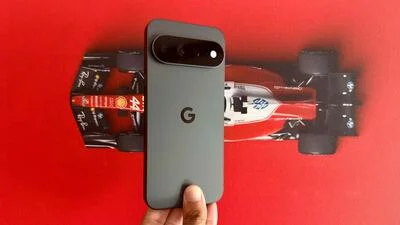
There is a certain something about the ‘Pro XL’ Pixel phone every year, that immediately gets my attention. I like large screen phones, that’s pretty obvious. I also have a preference for Google Pixel phones, over most other Android phones, if this was to be a regular device. This improved design works too.
There are some explainable reasons for the fondness towards Pixel phones (one goes back as far as the Nexus 6 and Nexus 6P from 2014 and 2015), but mostly, it is a subjective preference towards how well everything comes together. There is certainly some disappointment amidst a demographic of the social media audience, since Google didn’t make any wholesale design changes with the Pixel 11 series, but I’m not one of them.
One could argue on certain specs, or approach to certain experiential elements, but not the overall proposition. To be fair, at no point in the taxing review process did 12GB of memory ever hint at a bottleneck. It will absolutely not be a problem, even a few years later. You may see different results depending on usage, and my suspicion is Google had to slightly reduce battery capacity to open up a smidgen of space for managing thermals. There’s a big daily relevance aspect with the new Pixel phones and the Gemini collective (and that’ll pretty much push you to buy a Google AI Plus or Pro subscription). Of course, much of this integration is Pixel exclusive for now, and sets it apart from flagship competition. Proactiveness, is the pitch Google is going for, and with time, mileage will certainly get better. Live Translate for media playback and Circle to Search within the camera app, add utility. I’m not entirely sure how much of the AI feature set will work without a subscription if you choose to walk that path, and even for whatever remains unlocked, how those limits will shape up. Doing less, is a smart camera trick Subtle changes, such as smoother switching between lenses, and redone controls in the camera app, are noticeable. I’m a fan of the Natural camera look, and to be fair, Vanilla also works for some shots. Experiment a bit, you’ll have a lot of fun.
Because while long zoom capabilities are great to have, utility is genuinely limited (think about it, how many times have you used almost all of the zoom in the last year), even those are very usable photos, in more instances than you’d imagine—that’s a good thing,. Compared to the generation it replaces, the Pixel 11 Pro XL and indeed the Pixel 11 Pro do make do with 12GB RAM instead of 16GB RAM, but the positive side to that is there is no hint of a 128GB storage version at these prices, with 256GB and 512GB being the two configurations (the latter does get something called Zoned UFS, which may be faster; I cannot testify to those claims, either way). I am somewhat concerned about the comparatively lesser 5,115mAh battery (compared with the Pixel 10 Pro XL’s 5200mAh) battery capacity, though generational improvements elsewhere mean it isn’t faring any worse between charges. The 120x Pro Zoom which replaces the 100x Pro Zoom, works its magic with AI but the Pixel 11 Pro XL will also give you a non enhanced version to see the difference.
The Gemini notification indicator that now sits on the camera island, called HiLight, is useful for people like yours truly, who like to keep the phone face down on a table, when in a conversation (the idea is to give the human full attention, and not get distracted by the screen lighting up for notifications every few seconds). This will glow if you call out to Gemini with a query, and the visual cues are a good way to know that the artificial intelligence (AI) is listening. Entire conversations can be had, without having to lift the phone. Generational chip upgrade, to the Tensor G6, is the basis on which the new phones have been crafted. raw performance and benchmark supremacy game with competing flagship chips, the company’s approach has been one of focused optimisation and usability While many keep hoping that Google will get into a clock speed.
Across the board, there are improvements including claims of up to 20% better power efficiency, up to 15% faster app loading responsiveness, and a 50% more power tensor processing unit (TPU) which tasks such as computational photography and the broader AI suite, draw from.
