
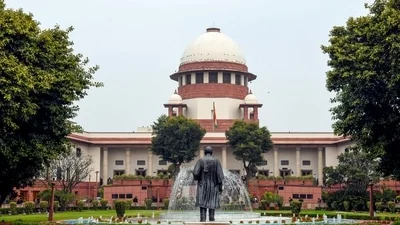
The Supreme Court announced a significant change on Friday regarding the selection process for judicial officers at the entry level. The court has reduced the mandatory legal practice requirement from three years to just one year. Additionally, selected trainee judges will now be required to complete two years of institutional training before they can assume their roles on the bench.
Providing a mix of legal practice, judicial training and first-hand experience of judicial decision-making, the court believed that the candidate could be assessed not just on legal knowledge, but also on the practical skills.
However, it added that the allowing “speed of entry” should not override the institutional need for experienced judicial officers.
At the end of the two year training—the first year at the judicial academy; six months with a district judge; and the last six months with a high court judge—the court required a report to be submitted by the concerned high court judge. The judicial officer will be regularised after the report is found satisfactory. During the period of training at the state judicial academy, the court held the trainee judge to be entitled to a fixed emolument equivalent to one-half of the remuneration payable to a Judicial Magistrate First Class in the concerned state. He would then serve as a clerk of either the Principal District Judge or District Judge or any senior judicial officer for six months providing a first-hand experience of conducting courts. The final six months phase will be under a high court judge who will prepare a report at the end of the training. After pronouncing the decision, the bench remarked, “We hope this is a workable solution. The idea is to attract the best of talent to the judiciary. The court arrived at its conclusion after going through suggestions from all high courts, law universities and other stakeholders. It was a common refrain that the three-year practice rule acts as a disincentive for law graduates desirous of serving the judiciary. At the same time, high courts cautioned that young graduates on becoming judicial officers lack expertise or training reflected in their inability to pass orders in crucial cases. There were complaints received of their temperament and rude behaviour with lawyers and litigants.
The bench said, “The assessment must include the candidate’s conduct, diligence, analytical ability, understanding of procedure, capacity to deal with cases, quality of legal reasoning and suitability for judicial office.
