
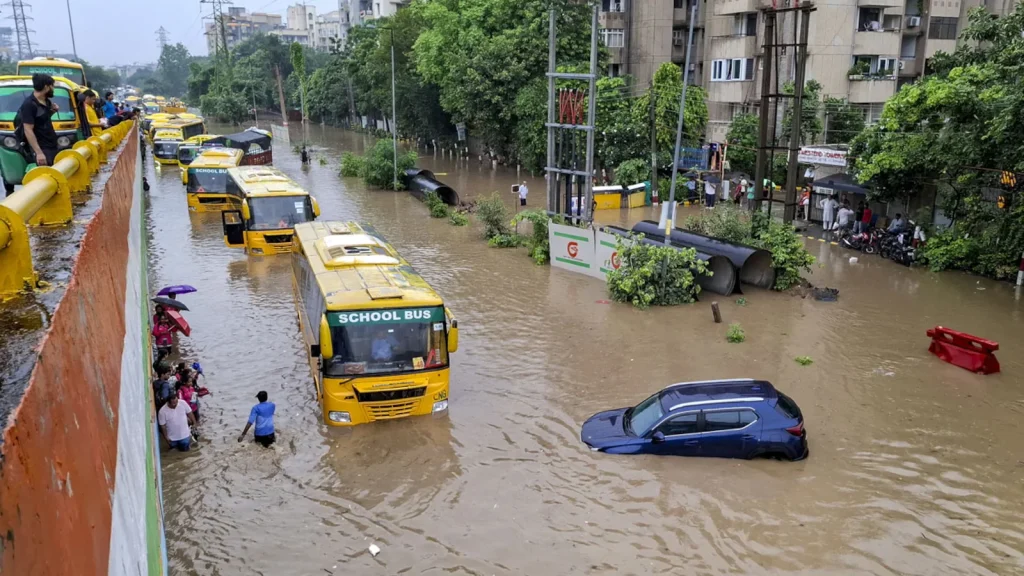
Every monsoon, Gurugram is confronted with the same paradox. A city celebrated as one of India’s most modern urban economies can be brought to a standstill by a few hours of intense rainfall. Roads become channels, underpasses become reservoirs, and traffic corridors become temporary floodplains.

Roads Must Be Part Of The Solution
That model is becoming increasingly inadequate. A resilient city follows a different hierarchy: Research on Gurugram has demonstrated the potential of precisely this approach. One recent study proposed integrating retention ponds into the existing drainage network and found substantial reductions in simulated flood volumes under both regular and extreme rainfall scenarios. This requires moving towards catchment-level stormwater modelling, using high-resolution Digital Elevation Models, rainfall intensity data, soil characteristics, land-use and land-cover data, drainage capacity, and existing water bodies. This is particularly important as rainfall patterns become more uncertain. A drainage system designed around historical rainfall statistics may perform adequately under an old climate regime but fail when rainfall arrives in shorter, more intense bursts. A Gurugram-specific study comparing increasing imperviousness with increasing rainfall intensity found that climate change could be the more severe threat to drainage-system performance, with the combination of urbanisation and more intense rainfall further worsening the risk. The city has the technology to model its catchments, the engineering capacity to redesign its infrastructure, and the economic resources to implement both. What it now needs is a change in planning philosophy.
A recent GIS and SWMM-based study of Gurugram examined eight high-runoff sub-catchments and found that a combination of green roofs, permeable pavements, and rainwater storage could reduce runoff volume by as much as 72.31% and peak discharge by 54.05%.
