
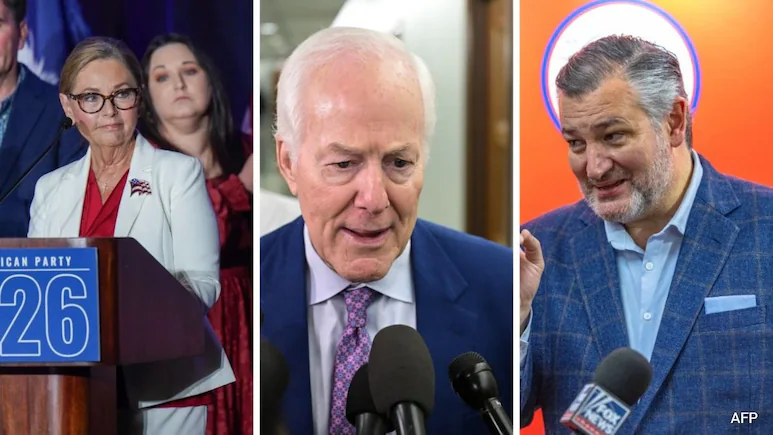
Democrat Annie Andrews has won an upset victory over Republican Darline Graham for a Senate seat in South Carolina, a sign that dissatisfaction with President Donald Trump has seeped into even some of the most conservative states.
Tom Kean of New Jersey and three Republicans in Pennsylvania, Ryan Mackenzie, Scott Perry and Rob Bresnahan, lost reelection and Democrats won open seats in North Carolina and Kentucky. Democratic Senator Jon Ossoff won reelection in Georgia, defeating Rep. Representative Chris Pappas won a Senate race in New Hampshire, defeating former Sen. Democrats had been cautiously optimistic heading into Tuesday as they watched Republicans spend the campaign’s final stretch pumping tens of millions of dollars into states and districts that Trump won handily two years ago, and watched Trump campaign across some of the reddest states. Several Democratic senators easily won reelection, including Sens. Harriet Hageman won a Senate seat in Wyoming, replacing retiring Sen. Kathy Castor won in metro Tampa, while others were holding their own as early returns were being counted across Florida. In early results, Democrats Josh Shapiro in Pennsylvania, JB Pritzker in Illinois, Wes Moore in Maryland, Maura Healey in Massachusetts and Kathy Hochul in New York all won reelection. In Ohio, Republican Vivek Ramaswamy lost to Democrat Amy Acton after his campaign faced backlash for an ad featuring Acton’s estranged mother, who lost custody of Acton decades ago after her husband, Acton’s stepfather, was indicted for raping Acton as a child. It could also complicate the paths of Vice President JD Vance and other Republicans who may be looking to turn their loyalty to Trump into momentum. (Except for the headline, this story has not been edited by NDTV staff and is published from a syndicated feed.) Earlier reporting noted: Roy Cooper flips key North Carolina seat beating Trump-backed Michael Whatley Democrats won major Senate races in North Carolina and Georgia, but it remained unclear whether the party would succeed in wresting control of the chamber from President Donald Trump’s Republicans with millions of votes still uncounted in Tuesday’s midterm elections.
Democrats have also flipped a seat in North Carolina and won key races in Georgia and New Hampshire on Tuesday as they tried to recapture majorities in Congress and break Republicans’ unified grip on power in Washington. Andrews’ victory is a defeat for Trump, who backed Graham despite doubts within his party, and it puts Democrats one seat closer to the net four they need to retake control of the chamber. Follow LIVE Updates here In the House, Democrats were marching toward control after defeating six Republicans in key battleground races. Republican Reps. Democrats need a net gain of three seats for a majority. Graham was appointed to the Senate in July after her brother, Republican Senator Lindsey Graham, died unexpectedly, and she decided to run for a full term of her own. Andrews, a doctor, will be the first woman elected to the Senate from South Carolina. Democrats who once saw the political map as an almost impossible lift are now hopeful that a Senate majority is within reach, even though their path runs through several more conservative states. Mike Collins and denying Republicans a seat they had once seen as a top pickup opportunity. John Sununu to replace retiring Democratic Sen. Jeanne Shaheen. Polls are still open in some states across the country as voters — angry over high prices and the war in Iran and concerned about government corruption — cast their ballots in midterm elections that will serve as a referendum on President Donald Trump’s second term. The elections could drastically shift power in Washington. They had bet that discontent over Trump’s failure to stop inflation and perceptions that he’s focused more on gilding the nation’s capital than easing their pain at the pump will turn the tide in their favor. Republicans had held out hope their money advantage would help stem the tide, but they were bracing to lose control of the U.S. House and fighting to hang onto the U.S. Cory Booker in New Jersey, Ed Markey in Massachusetts and John Hickenlooper in Colorado. Democrat Juliana Stratton was elected to replace Democratic Sen. Dick Durbin. On the Republican side, Sen. Wyoming Rep. Cynthia Lummis. In the House, Democrat Jamie Ager beat Republican Jennifer Capps Balkcom in North Carolina to give the party its first House flip. Another Democratic flip came in New Jersey, where former Navy helicopter pilot Rebecca Bennett defeated Rep. Tom Kean, who missed four months of votes in Washington this year as he underwent treatment for depression, a diagnosis he did not disclose until his return. Democrats need a net gain of four seats in the Senate to win the majority. They need three in the House. But as Democrats racked up victories. Trump rushed to duck blame for his party’s losses before polls on the west coast had even closed. Dissatisfaction was particularly high in blue states, but even in red states, a majority of voters were at least “dissatisfied. The economy helped key Trump’s White House comeback. Government corruption was also a big issue with voters. Despite their relative advantage on issues, the Democratic Party is not much more popular with voters than the Republicans. Republicans tried to buck historical precedent — a president’s party almost always loses seats during the midterms — with an aggressive redistricting effort aimed at creating a more favorable congressional map. But in Florida, where Republicans hoped to pick up as many as four new seats, the plan looked to be falling short. Republicans moved Democratic Reps. Jared Moskowitz and Debbie Wasserman Schultz into the same district — only to have them run in different territories and win. Democratic Rep. Other Trump choices could prove costly. In Texas, Trump worked to oust longtime incumbent Sen. John Cornyn in favor of scandal-plagued Attorney General Ken Paxton, setting the stage for an expensive race against Democratic nominee James Talarico, who Democrats hope may help them finally flip the state. In North Carolina, Sen. Thom Tillis retired after clashing with Trump. Then Whatley, Trump’s chosen replacement, struggled to gain traction against Cooper. Other outstanding Senate battlegrounds include Ohio, where Democratic former Sen. Sherrod Brown is challenging Republican Sen. Jon Husted, and Alaska, where the Trump administration filed a lawsuit to block certification of Senate results if Republican incumbent Dan Sullivan loses the race, citing the presence of a second candidate named Dan Sullivan on the ballot. Republicans hope they can hold seats in Iowa, Kansas and Maine and pick up Michigan, where Mike Rogers faces progressive Abdul El-Sayed — one of a crop of left-wing candidates who prevailed in Democratic primaries. El-Sayed’s former primary opponent, Haley Stevens, upended the race by endorsing Rogers, renewing focus on tensions over Israel and the party’s direction. In the House, Republicans are trying to hang on to their narrow majority, as Democrats aim to flip seats in states Trump repeatedly carried, from Florida to Texas to Iowa. Democrat Keisha Lance Bottoms of Georgia will be the first Black female governor of any state. In neighboring Florida, Byron Donalds became the first Black Republican to be elected governor in the nation. The results will shape the final two years of Trump’s second term. The Republican-controlled Congress acted as a rubber stamp to much of his agenda. Democrats taking control of even one chamber would open the floodgates to investigations and possible impeachments While Trump has proven adept at steamrolling efforts to rein him in. Defense Secretary Pete Hegseth and tech titan Elon Musk, a former top Trump adviser, are among possible targets. An especially strong showing for Democrats could boost the party’s large crop of potential presidential candidates.
She’s the first Democrat to win a Senate seat in the state in more than 20 years. Ashley Moody won a special election in Florida to finish the term of Marco Rubio, who became Trump’s secretary of state in 2025. More than 59 million people had already cast ballots before Tuesday, according to an Associated Press analysis, surpassing early-voter turnout from 2022. About 6 in 10 voters said Trump prioritizes his own personal interests more than the country’s interests. Beyond Washington, 36 states are electing governors. House Democratic Leader Hakeem Jeffries of New York, in line to make history as the nation’s first Black speaker of the House if his party sweeps to power, has outlined a 100-day agenda focused on lowering the cost of living and aggressively overseeing the Trump administration. Earlier reporting noted: Democratic Senator Jon Ossoff, widely seen as a potential 2028 presidential candidate, defeated US Representative Mike Collins in Georgia in a contest that was once considered competitive but moved out of reach for Republicans amid Trump’s declining approval ratings.
Trump, whose party has struggled when he’s not running to turn out the low-propensity voters who have fueled his victories, told voters to act as though he’s on the ballot, even as many Republican candidates kept their distance. “I wasn’t on the Ballot and if I was, we would have won IN A LANDSLIDE!” he wrote on his social media site. Voters were sour heading into Tuesday, with the midterm electorate deeply unhappy with the country’s direction and pessimistic about the future, according to The AP Voter Poll. Most said they feel frustrated, with about three-quarters saying they feel “angry” or “dissatisfied” with the country’s current trajectory. But the poll found that three-quarters of voters say the economy is “not so good” or “poor. About 8 in 10 say inflation has caused a “severe” or “moderate” financial hardship for their households. Roughly half cited it and the cost of living as “crucial” to their vote for Congress — higher than immigration enforcement policies, the war in Iran and artificial intelligence data centers. Just under half of voters have a “somewhat” or “strongly” favorable view of the Democratic Party, while about 4 in 10 view the GOP positively.
Senate — an outcome that seemed unlikely earlier this year, given a map widely seen as favoring their party. Earlier reporting noted: In North Carolina, former Governor Roy Cooper easily defeated Trump-backed Republican Michael Whatley to win a Republican-held seat, media outlets projected, giving Democrats one of the four net pickups they need to win a majority.
