
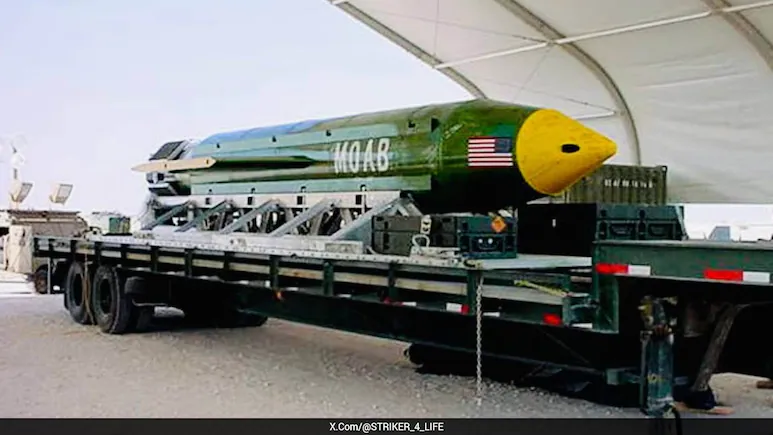
The ‘Mother of All Bombs’, officially known as the GBU-43/B Massive Ordnance Air Blast (MOAB), is one of the most powerful non-nuclear bombs developed by the United States. Weighing nearly 10,000 kilograms, the weapon is designed to destroy large military targets with a powerful explosion.
What Is the ‘Mother of All Bombs’? It is designed to target enemy positions, military equipment and large areas containing hostile forces. Unlike nuclear weapons, the MOAB uses conventional explosives and does not produce radioactive fallout. How Did It Get Its Name? The bomb’s official name is Massive Ordnance Air Blast, which gives it the abbreviation MOAB. The expression became widely recognised and is often linked to the weapon’s unofficial name. The weapon’s official designation and nickname are also documented by Air and Space Forces Magazine. When Was It First Used? The bomb was dropped on a tunnel and cave network used by terrorists near the Pakistan border. it is significantly less powerful than nuclear weapons Although the MOAB is among the largest conventional bombs used in combat. Its enormous blast and destructive capabilities have made it one of the most widely recognised weapons in the US military arsenal.
Because of its enormous size and destructive power, however, it became popularly known as the ‘Mother of All Bombs’. The GBU-43/B MOAB is a GPS-guided conventional bomb developed by the US Air Force Research Laboratory. It weighs approximately 9,800 kilograms, measures around 9.1 metres in length and contains about 8,480 kilograms of explosives. The bomb produces an explosion equivalent to approximately 11 tonnes of TNT. The weapon was developed and tested in 2003, according to a CNN report . The nickname also echoes a phrase used by former Iraqi leader Saddam Hussein, who described the 1991 Gulf War as the ‘mother of all battles’. The US Air Force acknowledged the nickname in a March 2008 article titled Five Years Later, It’s Still Known as ‘Mother of All Bombs’. The United States first used the MOAB in combat on April 13, 2017, targeting Islamic State militants in Afghanistan’s Nangarhar province. The strike marked the weapon’s first combat deployment, nearly 14 years after its development.
