
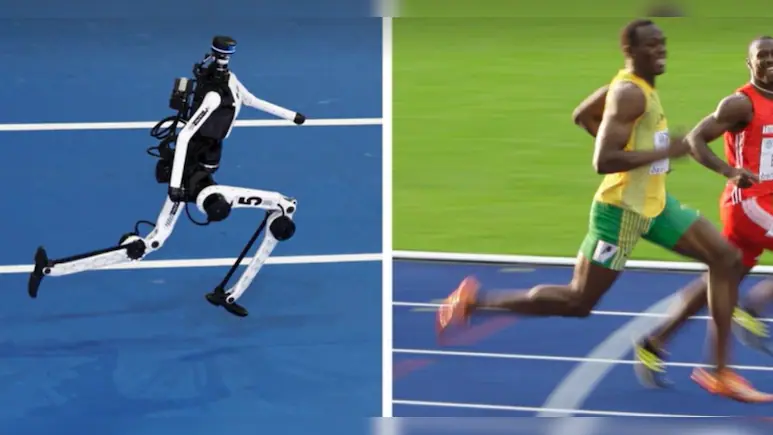
A humanoid robot developed in China has broken Usain Bolt’s world record in the 100-metre sprint, achieving a remarkable milestone in robotics. This development highlights the rapid advancements in technology, as robots increasingly demonstrate the ability to match and even exceed human performance in various fields.
But the robot did not beat Bolt by running like him, or like any human, sport science experts say. A SLOW START Take the start. Starting blocks allow human sprinters to generate horizontal force at the start of the race to build speed. Tiangong, by contrast, starts from a clunky, upright posture. In its first world record run, it also waited almost a full second to begin moving at the start, after apparently failing to register the signal. But then the robot’s advantages start to kick in.
In its final and fastest run, China’s Tiangong Ultra humanoid ran 100 m in 8.64 seconds, blazing past Bolt’s 9.58-second human world record. That amounts to an average speed for the robot of almost 42 kph (26 mph). But the differences between Bolt’s closely studied 2009 world-record run in Berlin and the humanoid runs in Beijing also highlight both the power of robots – and the areas, like decision making and perception, where they still lag, other experts said. Bolt burst from the blocks in Berlin with a lightning-fast reaction time of 0.146 seconds. Hunter estimates that Bolt would have hit the five-metre mark almost 2 seconds ahead of Tiangong.
“It is a remarkable advancement in technology where humanoids can keep balance and sprint at a speed that humans can’t catch up with,” said Jung Moon-hyun, a sports science professor at South Korea’s Chungnam National University. “If they could use starting blocks, I could see them getting a lot faster,” said Iain Hunter, professor of exercise science at Brigham Young University and a sport scientist with USA Track and Field. Tiangong Ultra’s developer said it had redesigned parts of the robot’s torso and waist to cut weight and reduce the effort needed to move its body while running.
Robots generate power faster with electric motors and gear boxes, said Park Hae-won, a professor at South Korea’s KAIST who leads the school’s humanoid lab. “Changing direction, or running and making a decision like, ‘I won’t run into this,’ and decelerating and reducing the robot’s speed. The result: an almost super-human cadence of shorter steps. NO METABOLIC ‘WALL’ BUT A REAL WALL Humans produce sprinting power through muscles and tendons working across flexible joints. Their ankles, knees and hips absorb force and return some of it with every stride. “An electric motor simply creates rotation. It doesn’t need to pull and extend like muscles do. You can simply attach it at the joint. Tiangong does not appear to slow. Race video shows Tiangong holding its highest speed through the final stage of its first record run – before crashing into a padded wall at the end. Jamkrajang agreed, saying robots capable of better turns and independent decisions would be more impressive than simple speed gains in future years. We haven’t seen this yet.” (Except for the headline, this story has not been edited by NDTV staff and is published from a syndicated feed.)
Bolt finished 100 metres in 41 steps. Tiangong appears to take more than 50 steps to finish in its first world-record-breaking run but those steps are far faster than Bolt’s, a Reuters review of the race video shows. Even world-class sprinters start to tire and slow in the final 20 metres as neuromuscular fatigue hits, said Matt Bundle, a biomechanics expert at the University of Montana.
It also improved the robots’ motors, range of movement and control software, according to Guo Yijie, a manager in its humanoid innovation department. Park Suhan, a robotics professor at South Korea’s Kwangwoon University, said the robot’s gait appeared to reflect what its motors can do best, rather than an effort to mimic human sprinting. Parunchaya Jamkrajang, a sports scientist at Thailand’s Mahidol University, said the smaller, choppier steps could help robots balance. “They try to increase speed, but if the stride becomes too wide, they will fall,” she said. “Because the robot isn’t constrained like that,” he said, “it’s going to be able to keep going. “It’s no good if we get up to a good top speed, but all we do is end up in a heap of broken bones because we can’t stop,” Bundle said.
