
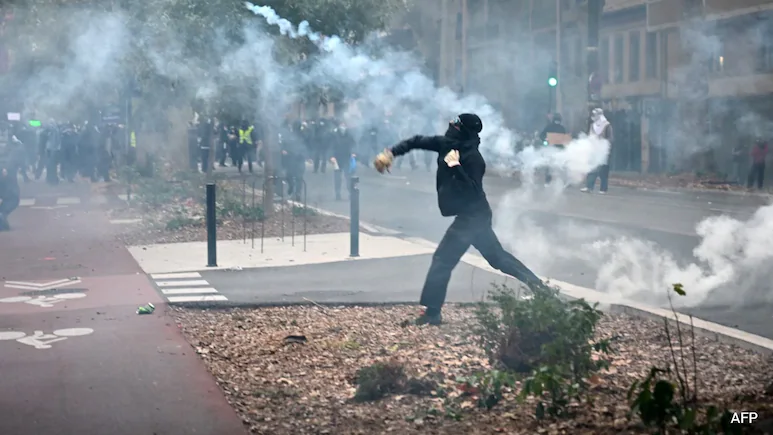
France’s government pledged Monday to replace its national online university admissions platform, seeking to quell student anger after weeks of often violent mass protests over education and living costs.
The concessions target the school grievances that helped ignite the unrest. But the movement has widened to include workers demanding relief from rising living costs, making the government’s task tougher than simply resolving a dispute over university admissions. The announcements followed France’s worst unrest in years on Oct. Groups of protesters set fires, looted shops, clashed with police and attacked public buildings, briefly storming Marseille’s City Hall and setting Limoges’ 19th-century town hall ablaze. The fire brought down the Limoges building’s roof and clock tower. Further demonstrations are planned. A committee involving students and teachers would produce initial recommendations for the replacement system by the end of November. Macron and his centrist government have faced criticism for failing to address students’ grievances since high school blockades began in mid-September. The protests have led to mass arrests and scrutiny of police riot control weapons blamed for life-changing injuries suffered by some teenagers. The demands for better-resourced schools, particularly in poorer communities, come as France grapples with record poverty and record public debt. (Except for the headline, this story has not been edited by NDTV staff and is published from a syndicated feed.)
Ministers also pledged up to 4 billion euros ($4.5 billion) in loans for school renovations, alongside smaller classes, more teaching and higher education posts and increased student grants. 17, when demonstrations over school funding and rising living costs descended into rioting and looting across the country. About 2,400 people were arrested in connection with the demonstrations, in which hundreds of thousands marched peacefully. He pointed to students’ demand for 250,000 more university places, compared with the government’s pledge of 15,000 additional places in higher education. The 2028 deadline puts a central concession to protesters beyond President Emmanuel Macron’s time in office, leaving his successor’s government to deliver it. The government also promised 15,000 additional places in higher education across 2027 and 2028, mostly in vocational and technical programs, and increases in student grants linked to inflation from the start of the 2027 academic year. To address demands for better learning conditions, the government pledged to cap some first-year high school classes at 28 students from 2027, starting with more disadvantaged schools. It also promised to cancel planned cuts to teaching positions at secondary schools and create 500 additional jobs. Authorities deployed 70,000 police officers and gendarmes to prevent a repeat of the previous weekend’s widespread destruction. Interior Minister Laurent Nuñez said Monday that 1,435 people had been arrested nationwide in connection with the latest weekend’s protests.
Higher Education Minister Philippe Baptiste announced “substantial change” to the platform next year, before its replacement in 2028. “We have managed to address some of the students’ demands,” said Nathanaël Combary of the high school group Renouveau Lycéen. “I emphasize the term ‘some.'” Other representatives were more critical. “We have received crumbs compared to what we are asking for,” said Clément Vieillot of the Mouvement Cachan 94 student group. The government said that it would introduce legislation if the proposed changes require it. “I have asked the government to address the legitimate demands at the root of this protest movement,” Macron said.
Two high school student groups welcomed some concessions, but called for protests to continue. Le Pen’s National Rally party has sought to capitalize on the unrest, presenting itself as a force for law and order and urging voters to channel their anger into support for her presidential bid. The university admissions replacement system still has to be designed, and legal changes may be needed — leaving crucial decisions unresolved even as the government seeks to persuade students to end their protests. The platform, called Parcoursup, allows students to apply to universities and other higher education courses and receive admissions decisions. It has been a focus of the protests, with students criticizing unclear selection criteria and unequal access to their preferred courses. The platform would provide explanatory information with each rejection, and institutions would have to give applicants the reasons for their decisions if requested.
Macron can’t seek a third consecutive term in 2027, and far-right leader Marine Le Pen leads polling before the first round of presidential voting on April 18. A winner-takes-all runoff is scheduled for May 2. A record 1.05 million people applied through it this year, according to the Higher Education Ministry. For the 2027 admissions round, institutions would publish more detailed selection criteria.
Earlier Monday, the French president promised “concrete measures” to address students’ demands during a visit to the southern port city of Marseille.
Their representatives spoke after meeting with Prime Minister Sébastien Lecornu earlier Monday.
Another round of nationwide demonstrations on Saturday saw less violence. The building plans would extend still further into the next presidency. The government proposed up to 4 billion euros ($4.5 billion) in low-interest loans to regional authorities for school renovations through 2030. A separate 1 billion-euro ($1.1 billion) state plan would fund university renovations through 2029. Authorities estimated turnout at 410,000, while organizers put it at nearly 800,000.
