
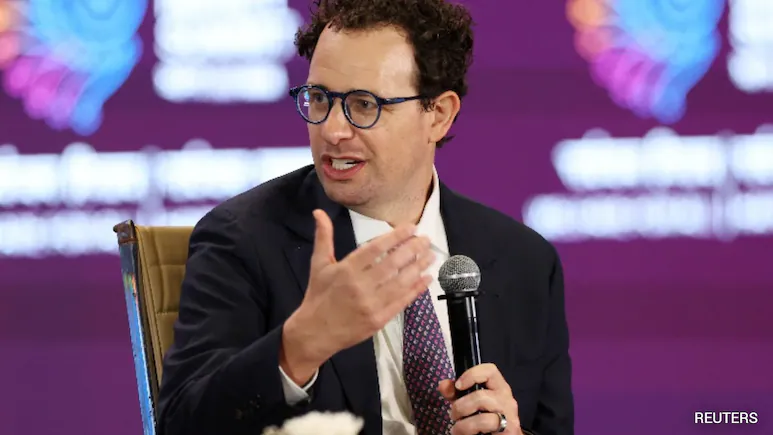
“If we take the right paths, then the chance of something going wrong is very low.
If we take the wrong path, then the chance of something going wrong could be even higher,” Anthropic CEO Dario Amodei said, as he renewed his call for slowing the pace of artificial intelligence development, arguing that the industry needs more time to put adequate safety measures in place as AI systems become increasingly powerful.
In an exclusive interview with CNN’s Anderson Cooper on Saturday, Amodei addressed concerns raised by former Anthropic researcher Jacob Coxon, who recently quit his job and publicly warned about the risks posed by advanced AI. In an interview with Fortune published on Saturday, he said the company would not launch its planned stock market debut this year.
Responding to a question about whether AI could kill humans and the probability of such an outcome, Amodei said he agreed with Coxon’s concerns more than he disagreed with them.
In a post on X on Saturday, Altman endorsed one of Amodei’s key proposals and said OpenAI would implement a similar measure. “I agree with Jacob much more than I disagree with him. I think Anthropic is the most aware of these issues. He wasn’t calling out to us. I think there’s some chance that things will go wrong. But it’s not all that high. But again, I think it’s more illuminating to think in terms of how do you decompose those probabilities? He added that the outcome would depend on how governments and companies respond to the technology’s rapid progress. And if we take the right paths, then the chance of something going wrong is very low. If we take the wrong path, then the chance of something going wrong could be even higher than that. So, let’s focus on our agency and our ability to take the right paths instead of the wrong paths. And I think that the way to take the right paths is for the industry to work together. It is harder but to some extent, the world has to work together. “The people building AI earnestly believe that it could kill us all by the end of the decade. This is not a marketing stunt. If anything, many executives and senior researchers will couch their phrasing in the press to sound sensible – but I hear the same people express fear privately. No other human activity poses this level of danger,” Coxon wrote on X. I’ve written a lot about them too. They include the risk of losing control of AI systems, misuse of AI for cyberattacks and bioterrorism, and serious economic disruption. A race to the bottom, spurred by commercial incentives, can make these risks more acute. He added, “We must slow the pace at which we improve the capabilities of AI models. Progress will still seem fast, and we must make wise use of the time we gain. Amodei’s proposal has received backing from leaders of other major AI companies. However, he reportedly acknowledged that not all companies may agree to such an approach. “I agree with Dario that we need to pace the frontier. This has been a primary topic of discussions we’ve had at OpenAI in recent weeks. Committing to having independent evaluators with employee-like access is a great idea, and we will do the same. We’ll have more to share soon. Altman also indicated that OpenAI remains focused on safety and alignment as AI capabilities continue to advance. “Yeah, we got a lot of stuff to do, like meeting this moment of what is going to be required for safety and alignment, and how the industry and governments can work together. Tesla and xAI CEO Elon Musk also supported Amodei’s concerns, writing on X, “Dario is right.
Because when he left, he said, ‘I think Anthropic is the most responsible player, it’s an interesting resignation. Because it’s kind of an easy way to express, i used to talk in that kind of way. Because it is such a powerful technology, these risks are serious, “But like many technologies before it, AI brings risks, and.
“And so, instead of saying it’s a 10% chance that sounds like it’s a roll of the dice, I think it’s much more illuminating to say that forks into different paths. Read: ‘AI Swarm Could Take Over Internet In 6 To 12 Months,’ Anthropic CEO Warns Amodei’s remarks come after Jacob Coxon, an AI researcher who worked at both Anthropic and OpenAI, resigned and accused leading AI companies of taking unacceptable risks in their pursuit of increasingly powerful systems. In a social media post that received more than 150 million views, Coxon said the people building advanced AI believe it could pose a threat to humanity within the next decade.
He was calling out the dynamic of the industry as a whole moving too fast,” Anthropic CEO said. Read: Musk, Altman Say They Agree With Anthropic CEO On Slowing Down AI Development Amodei said discussions about AI risks are often framed in terms of probabilities, but he believes it is more useful to focus on the choices being made by the industry. “I think I already said these unconditional probabilities. What are the paths in which things go well and what are the paths in which things go poorly,” Amodei said. If we go too slow, I still believe that the wrong people will be in charge of the technology and that again will bring the probability of things going wrong very high,” he said. In a recent blog post , Amodei warned that AI carries serious risks despite its benefits and said competition among companies could make those risks worse. OpenAI CEO Sam Altman said his company is also considering ways to pace the development of advanced AI systems. Altman told employees during a company-wide meeting that OpenAI could potentially slow AI development, possibly alongside other leading AI labs, according to people familiar with the matter. “I would say not 2026,” Altman said. UN human rights chief Volker Turk urged countries earlier this week to put “cast-iron guarantees in place around the safety and security of AI before it is too late.” (With inputs from agencies)
