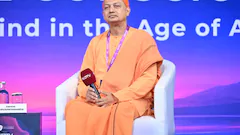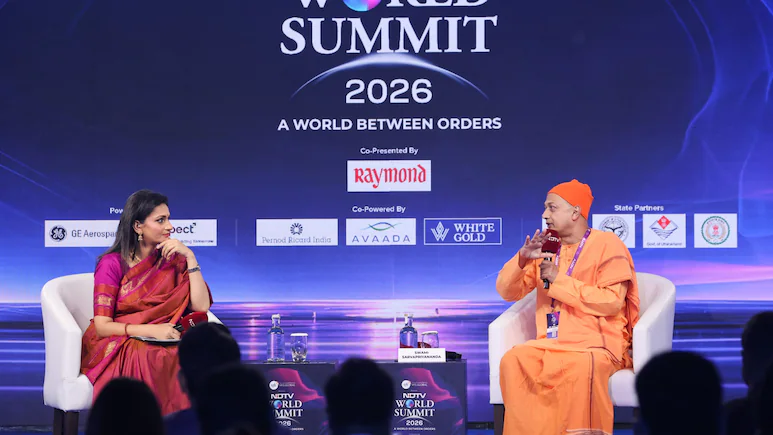
Artificial intelligence can display intelligence, imitate human behaviour and even be guided by moral principles. But does that mean it possesses consciousness? Swami Sarvapriyananda , a monk of the Ramakrishna Order, argued that intelligence and consciousness are two distinct things, drawing on the philosophy of Vedanta to explain why a machine that behaves like a human mind may not necessarily be conscious.
Speaking at the NDTV World Summit, Swami Sarvapriyananda said the distinction between the mind and consciousness, central to Vedanta, is crucial to understanding the debate over artificial intelligence.
I just saw the article yesterday, that finally the leading science journal in the world has come to the same conclusion we came to thousands of years ago in the Upanishads, that intelligence and consciousness are two distinct things,” he said. NDTV World Summit: Track Live Coverage “The philosophy of Vedanta makes a distinction between mind and consciousness. Swami Sarvapriyananda explained that modern philosophy often treats intelligence, emotions, perceptions and consciousness as properties of the same entity – the mind. He added that Vedanta makes a clear distinction between intelligence and consciousness. To explain the difference, the monk pointed to the ability to experience pain, arguing that intelligence alone does not establish consciousness. “The computer Deep Blue was the first computer to beat a chess grandmaster. But a mouse is not as smart as Deep Blue. It can’t beat a chess grandmaster, but a mouse can feel pain. If a cat catches the mouse, you can clearly see it feels pain, whereas Deep Blue cannot feel anything. Dwelling on the distinction between intelligence and consciousness, Swami Sarvapriyananda explained how Vedanta approaches the relationship between the observer and what is observed. “Whatever you experience, whatever you can label as this – like this bottle – then it’s not you. It’s other than you. You are distinct from it. He extended this reasoning to the human body, thoughts, ideas, memories and intelligence, arguing that these can also be observed and experienced. “Even thoughts, ideas, intelligence, those are also objects. “The intellect by itself is not conscious. The argument challenges the assumption that an AI system capable of reasoning or producing human-like responses must also possess an inner experience. A machine may perform tasks associated with intelligence, but whether it experiences anything remains a separate question. Swami Sarvapriyananda also discussed Anthropic’s efforts to shape the behaviour of its AI model Claude through a framework. He explained that simply instructing an AI system not to do something may not always be enough to produce the desired behaviour. The weightage was given to the Golden Gate Bridge in San Francisco. The maximum as high as it could get. And then Claude started using Golden Gate Bridge for everything. You ask Claude to write a poem about Golden Gate Bridge. “Claude gave a very nice answer. The example, he explained, illustrated how the relative weight assigned to different elements within an AI system could influence its behaviour. He added that Anthropic had sought inputs from different religions and philosophical traditions to help shape the model’s moral framework. When asked what increasingly human-like AI systems mean for human relationships and our understanding of personhood, Swami Sarvapriyananda argued that treating AI as a person in human interactions could have implications for how people treat one another. “The answer is, when we deal with human beings, we deal with them as persons. These machines are designed to imitate human beings in their interaction with us. Now, if you do not treat a near human personality as human, imagine what we will do to other human beings. He highlighted what he saw as a convergence between the distinction made in modern discussions of consciousness and the position articulated in Vedanta. “And I was so glad to see. The monk’s central argument was that the ability to process information, solve problems or imitate human thought should not automatically be equated with consciousness.
“All of that Claude already knows, but to increase the weightages on so that it is a morally better being – a sentient being.
Consciousness and mind are literally not the same thing,” he told NDTV’s Gaurie Dwivedi, the moderator of the session. Consciousness and intelligence are not the same thing,” he said. The subject is distinct from the object,” he said. And consciousness is that which is a witness and experience of the intellect,” he said. “They said they increased the weightage. You ask Claude to plan a vacation, it’ll say go visit the Golden Gate Bridge,” he said. When the system was subsequently instructed not to refer to the bridge, it still returned an answer that ended with a declaration in capital letters, according to his account. But at the end, in capital letters, it said I cannot help it, Golden Gate Bridge,” he said. “So, depending on how the weightages are in Claude’s “mind”, personality will change. So the moral formation of these AIs is very important, the guidelines which are given,” he said. If not sentient, at least a being,” he said. It’s good for us to treat a human-like entity as human,” he said. Swami Sarvapriyananda said he was encouraged by a recent article in Nature that, as he described it, argued that AI is not conscious or cannot be conscious.
To illustrate the point, he described an example involving an earlier version of Claude and the Golden Gate Bridge in San Francisco.