
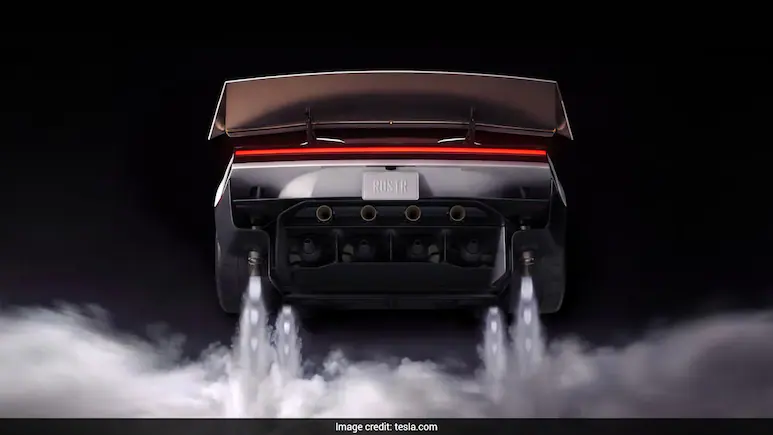
Tesla’s next-generation Roadster has taken its flying-car ambitions to the next level, with a demonstration showing the electric sports car briefly leaving the ground and landing safely using rocket-style thrusters. But while the spectacle has raised questions about the future of personal transport, several important details remain unanswered, from its flight capabilities and final price to the licences and safety requirements owners might need.
Tesla has not released verified figures for the Roadster’s flight altitude, horizontal distance or time spent airborne. However, this figure refers to its position on the ramp and should not be interpreted as a confirmed free-flight altitude. Tesla has not announced a definitive set of licensing, training or insurance requirements for using the Roadster’s thrusters. That figure, however, should not be treated as the confirmed price of the redesigned model.
The vehicle was also shown jumping over other cars. A post shared by NDTV WORLD (@ndtvworld) Tesla has not disclosed precise measurements of the demonstration’s flight altitude, distance or duration. The event established that the vehicle could briefly leave the ground under controlled conditions, but it did not demonstrate sustained flight or the ability to travel long distances through the air. Here are the key questions about Tesla’s redesigned Roadster, answered. Reports from the demonstration described a brief aerial manoeuvre, rather than sustained flight. For now, Tesla’s demonstration does not establish whether the Roadster could clear substantial obstacles, remain airborne for an extended period or travel meaningful distances without touching the ground. The answer will depend on the final design of the vehicle and how regulators classify its airborne capabilities. If the Roadster is approved for conventional road use, its owners may be able to drive it under the usual motor vehicle licensing framework. However, operating a vehicle as an aircraft could bring additional aviation requirements into play, depending on the jurisdiction and the nature of the flight. Insurance could present another challenge. Standard motor insurance may not cover damage or injuries arising from airborne manoeuvres. Insurers would need to assess the risks and determine what coverage is appropriate. For Indian buyers, the applicable requirements would depend on Indian motor vehicle, aviation and safety regulations. Rules applicable in the United States would not automatically apply in India. In short, buying a Roadster would not necessarily give its owner permission to activate its thrusters wherever they wished. Tesla has yet to confirm the final purchase price of the redesigned Roadster. Reservation deposits associated with the newer versions have also drawn attention.
The demonstration , held at SpaceX’s testing facility in McGregor, Texas, on October 15, showcased the Roadster performing an aerial manoeuvre after driving up an inverted ramp. One report put the vehicle’s position at approximately 21 metres above the ground during the ramp manoeuvre. When the second-generation Roadster was announced in 2017, Tesla quoted a starting price of $200,000. Reports on Tesla’s reservation listings have cited deposits of $50,000 for the Performance version and $250,000 for the Thrust version.
Energy and range: A vehicle needs to carry a supply of pressurised gas. The available thrust and the duration for which it can be sustained depend on the system’s design and capacity. Safety: A malfunctioning valve, unexpected thrust or loss of control could have serious consequences, particularly on crowded roads. Any production system would need rigorous testing and safeguards. Weight and complexity: Pressure vessels and associated hardware add weight and engineering complexity. Designers must balance these demands against the performance and efficiency expected of a sports car. Regulation: A car that can leave the ground raises questions about airspace, permitted take-off and landing areas, vehicle certification and liability in the event of an accident. Everyday usefulness: A short jump over an obstacle may be visually spectacular, but it does not necessarily help a driver navigate ordinary traffic. The technology’s practical value will depend on what the vehicle can reliably do outside a controlled demonstration.
Its final purchase price has not been confirmed and Tesla’s website says it has not ben approved for public road use. The Rocket version, which features a more ambitious flight system and has been described as a single-seater, is aimed at an even narrower market. The Roadster is unlikely to be a mass-market vehicle. Its potential customers include wealthy car enthusiasts, performance-car collectors and technology early adopters willing to pay a premium for experimental engineering. In principle, yes. Thrusters generate force by expelling gas at high speed, and the technology can be used to produce short bursts of thrust. The harder question is whether such a system can be made practical and safe for everyday driving. The Roadster’s proposed system uses cold-gas thrusters developed with SpaceX’s involvement. Unlike conventional rocket engines, cold-gas systems generate thrust by releasing pressurised gas rather than burning rocket fuel. However, several obstacles remain. Until Tesla provides more technical details and independent testing becomes available, the everyday usefulness of rocket-style thrusters remains an open question. The demonstration showed the Roadster briefly leaving the ground and landing, but Tesla has not established a sustained airborne range, a defined flight duration or a practical system for routine take-offs and landings. The Rocket version has also been described in reporting as not approved for public-road use. Its final regulatory status and the conditions under which its flight system could be operated remain important unanswered questions. A car that can perform an aerial manoeuvre is not automatically a flying car capable of replacing conventional transport. For that to happen, the technology would need to demonstrate repeatable performance, reliable safety systems, practical operating costs and compliance with the relevant road and aviation regulations.
Tesla has indicated a production timeline of 2028 , but that does not guarantee that deliveries will begin as planned.
