
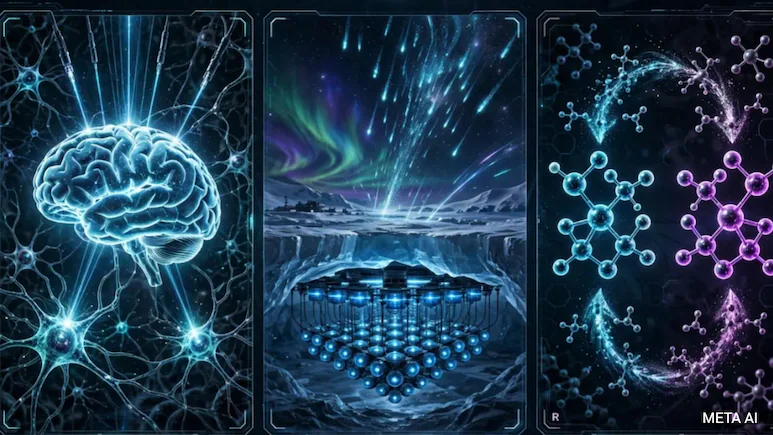
This year’s Nobel science winners were honoured for their research on tiny particles from space, using light to control brain cells, and studying mirror-image molecules. The 2026 Nobel science prizes have recognised discoveries that mirror something straight out of sci-fi films.
Halzen realised in the 1980s that scientists could use these particles to study some of the universe’s most powerful objects. The challenge was to build a detector large enough to catch them. Nobel Prize in Physiology or Medicine has been awarded to Karl Deisseroth, Peter Hegemann and Georg Nagel for their research on using light to control brain cells.
Construction of the IceCube observatory began in 2004 and was completed in 2011. Within two years, it had detected 28 high-energy cosmic neutrinos.
The research began in the 1990s when Hegemann was studying a type of single-celled algae called Chlamydomonas. He noticed that the algae responded to light much faster than the human eye. He suspected that the algae had a special protein that helped them react quickly to light. With the help of Nagel, he studied two genes that produced light-sensitive proteins. Scientists now use it to study conditions such as depression, schizophrenia, dementia, anxiety and addiction. They are also exploring whether it could help restore vision in people with certain types of blindness.
He showed that chemical reactions could increase the difference between the two forms of a molecule beyond what scientists had expected. This year’s Nobel-winning research shows how scientists are finding new ways to answer questions that once seemed impossible to solve. Kagan made an important discovery in 1986.
