
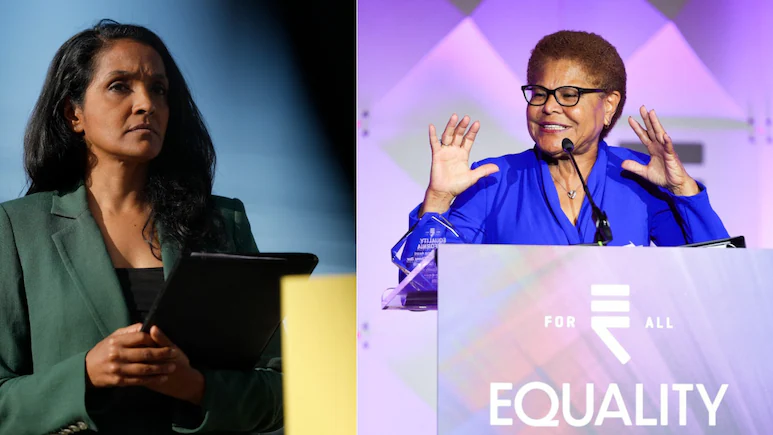
On November 3, when American voters will choose who will govern the US Congress by exercising their franchise in US midterms, an interesting electoral battle will play out in Los Angeles: The mayoral polls. The contest for the mayor’s office has an interesting dimension: 45-year-old Nithya Raman, an Indian-origin politician and city council member, is challenging incumbent Karen Bass, 73, in a race that will determine who gets to steer one of America’s largest municipal governments. Whoever wins the election will oversee a city with an annual budget of nearly $15 billion – a sum comparable to the public spending of entire countries.
an urban planner and Los Angeles City Council member, is positioning herself as a candidate of change, Bass is seeking another term, defending her administration’s record While Raman. More than political leadership, the battle is also about who gets to control the city’s enormous public purse, how the money is spent, and whether the second-largest US city can address some of its most persistent problems, including homelessness, housing affordability and public safety. Born in India, she moved to the United States at the age of six. She studied at Harvard University and earned a master’s degree in urban planning from the Massachusetts Institute of Technology (MIT). Before entering electoral politics, Raman worked on homelessness-related initiatives in Los Angeles and co-founded the SELAH Neighbourhood Homeless Coalition. Her political career has largely focused on housing, homelessness, tenant protections and urban planning. She has championed stronger protections for renters and advocated changes to the city’s approach to homelessness. She initially endorsed Bass before launching her own mayoral campaign, arguing that Los Angeles needed a different approach to running the city. Karen Bass is seeking a second term as mayor. Bass has made homelessness, affordable housing, public safety and economic recovery central to her administration. Her signature homelessness initiative, Inside Safe, seeks to move people living in encampments into temporary accommodation and eventually permanent housing.
Because she was once a political ally of the incumbent, raman’s challenge to Bass is particularly interesting. Raman is a member of the Los Angeles City Council representing District 4. She was elected to the City Council in 2020, becoming the first South Asian to serve on the council. A veteran politician, she previously served in the California State Assembly, including as its speaker, and represented California in the US House of Representatives before becoming mayor in 2022. However, her tenure has also faced scrutiny over the city’s response to the January 2025 Palisades wildfires, the pace of homelessness reduction and the delivery of basic civic services.
Why Is This Election Significant?
In choosing the next mayor, the voters will have to choose a candidate who can translate that financial muscle into tangible improvements in the lives of its residents. Police services account for approximately $3.56 billion, or 24% of the total budget, according to the City Controller’s FY2026-27 budget dashboard. Fire services account for another $1.51 billion, while sanitation receives approximately $1.07 billion. Housing receives approximately $385 million, while transportation accounts for around $398 million. What makes the Los Angeles mayoral battle interesting is the fact that neither candidate secured an outright victory in the June 2 primary, in which candidates needed more than 50 per cent of the vote to win. Bass received approximately 34 per cent of the vote, while Raman secured around 29 per cent. The hosting of 2028 Olympics adds another dimension to the mayoral responsibility. Bass is using the Olympics to counter attacks from Raman, who had opposed the bid in 2020 and vowed to fire the chief of the Los Angeles Police Department (LAPD). The 73-year-old says this will put the city’s image in jeopardy and give a chance to Washington to intervene.
The voters of Los Angeles face a choice between “rising star” Raman and the experienced Bass.
The spending priorities reflect the scale of the challenges confronting the city. Its next mayor will have to balance demands for public safety, housing, infrastructure and social services while managing competing financial pressures. The mayor proposes the city’s annual budget, but the City Council plays a central role in examining and approving it.
The person occupying the mayor’s office therefore has considerable influence over spending priorities but does not exercise unilateral control over the entire budget.
