
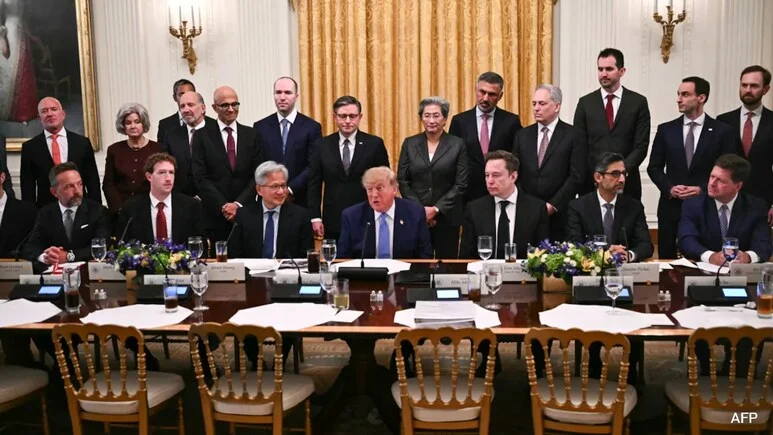
The AI agreement announced by US President Donald Trump on Tuesday reportedly started with a discussion between Meta CEO Mark Zuckerberg and House Speaker Mike Johnson last week.
The AI agreement announced by US President Donald Trump on Tuesday reportedly started with a discussion between Meta CEO Mark Zuckerberg and House Speaker Mike Johnson last week.
The agreement was signed by Meta, OpenAI, Anthropic, xAI, Google and Nvidia. Zuckerberg and Johnson discussed concerns around AI regulations during the state dinner. The Meta CEO then spoke to his Nvidia counterpart Jensen Huang about putting together a set of principles that major AI companies could agree on before their next meeting with Trump. The Meta CEO later shared a draft of the proposal with other executives ahead of Tuesday’s meeting at the White House. Huang also helped bring other AI companies on board. Executives from OpenAI, Anthropic, xAI and other technology companies attended the meeting with Trump. It asks the companies to have strong safety checks for their advanced AI systems and allow outside groups to audit them. The agreement, however, does not give many details about how these checks and audits will work. “The idea isn’t that this is the only thing that we will ever do. Zuckerberg’s involvement comes after years of tension between Meta and US lawmakers.
Following the 2016 presidential election, he had faced questions in Congress over issues including election interference, privacy and child safety on social media.
The two were seated next to each other at the event held for Chinese President Xi Jinping, according to Semafor . The 47th US President later released the proposal as the “White House Accord on Super Intelligence”. It also says that government regulation of AI may be needed in the future. During the meeting , Trump said the US would officially use “Super Intelligence” instead of “Artificial Intelligence” in government communications. He said the term “artificial” was not appropriate because the technology was not “artificial”. Read: US Government’s New AI Chatbot Pulls Back From Debunking Trump Zuckerberg called the agreement a “good step forward” after the meeting. It is that this is a start and an accord that the whole industry could come to,” he told reporters.
