
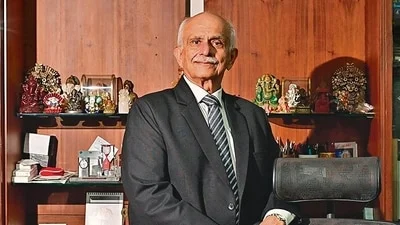
The Bombay Bar Association (BBA) recently convened a meeting to protest against the Emergency, highlighting significant moments in the history of the Bombay High Court. Senior advocate Nitin Thakker, 79, reflects on the court’s storied past, including the impactful stories of renowned criminal lawyer Ram Jethmalani and his ‘ghoda-gaadi’ (horse carriage) in pre-independence Karachi.
Thakker also recalls the pivotal moment in 1960 when Maharashtra was carved out from the larger Bombay state. Another historical highlight was the immediate response of Bombay High Court judges in 1979, who rose from proceedings upon learning of Jayprakash Narayan’s death. These events illustrate the rich legacy of one of India’s oldest high courts and its influence on the nation’s development as a vibrant “city of dreams.”
With humble beginnings in Kalbadevi, once a hotspot for cloth trade and home to a large Gujarati community, Thakker is now a resident of the upscale Altamount Road. His father, Gordhanbhai Thakker, a lawyer and later a judge, worked closely with freedom fighter Bhulabhai Desai. His mother Sarlaben Thakker too distributed information pamphlets about the movement. It did not leave a lasting impression. “I visited the court during my school holidays. He studied in the St. Xavier’s Boys Academy’s Gujarati-medium school. He treasured a memory of his principal, a Spanish priest who spoke Gujarati and had the novel idea to raise funds for a new school building in the early 1960s. He remembered making a dash as a school boy to the SNDT university after hearing of Prime Minister Jawaharlal Nehru’s arrival. “We just got a glimpse of him when he came out of the gate. In those days, the PM didn’t have the kind of security they have now.
His first courtroom visit was at age 11 when his father, then a sessions court judge, presided over a criminal trial. One of his early childhood memories was watching the funeral procession of then deputy prime minister Vallabhbhai Patel in 1950 as it passed his balcony.
I was perhaps too young to decide anything,” said Thakker. “They had a screening of (the film) Mughal-e-Azam and we, the children from Gujarati-medium, were asked to sell tickets,” Thakker reminisced. Political leaders were far more approachable and they had a clean image,” said Thakker.
Family Dynamics of a Legal Professional
Thakker’s wife, Nalinee, pursued a law degree 11 years after their marriage in 1969. Despite this legal influence, neither of their two children chose to follow in their parents’ footsteps. Thakker, now a grandfather to three college students, shared that the family’s affection is largely directed towards Atom, their seven-year-old goldendoodle.
Thakker was present in Room No. “Hardly any lawyers participated in the general body meeting or debates we held before that. But that day was chock-a-block. There weren’t enough chairs.
Because there was no AC…The resolution was passed with an overwhelming majority,” said Thakker, we were all standing with all the doors open. 57 of the HC.
In 1975, during the Emergency that Thakker describes as a “blot on our democracy”, BBA passed a resolution to abstain from court as a mark of protest.
