
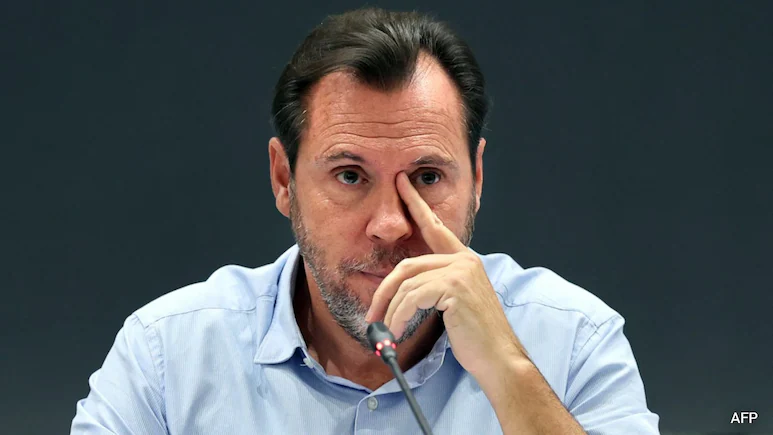
Spain’s transport minister announced Tuesday that he is stepping down, six days after a high-speed train collision south of Madrid killed 69 people.
Earlier Tuesday, Puente announced additional safety measures the government would implement on the rail network, including improving conditions in control centers and pushing for a faster rollout of the standardized European Rail Traffic Management System for safety and signaling. (Except for the headline, this story has not been edited by NDTV staff and is published from a syndicated feed.) Transport Minister Óscar Puente made the announcement at the end of an hours-long appearance before lawmakers about the crash — the second such deadly collision this year involving Spain’s extensive high-speed rail network. “It’s a question of political dignity, coherence and empathy with the victims.
“A transport minister in a country like Spain cannot continue in his post after two accidents in less than a year,” Puente told lawmakers.
The collisions have raised fresh concerns about the safety of the country’s rail network and the most recent crash came four weeks before a national election. Spain’s high-speed rail network has been considered one of the country’s crowning achievements. It is the world’s second-largest, after China’s. Until this year, it had not experienced a deadly crash since coming into service over three decades ago.
The chain of events that led to disaster started when the communication system key to the functioning of the security system on the Madrid-Seville line went down. Central controllers in Madrid took over and gave the go-ahead for one train to proceed, even though there was a stationary train ahead. It was the second major crash on the Madrid-Seville line this year. That crash remains under investigation.
The October 28 crash took place when a high-speed train slammed into another that had stopped on the tracks. In January, more than two hours further south along the route, a train derailed and struck another traveling in the opposite direction, killing 46 people.
