
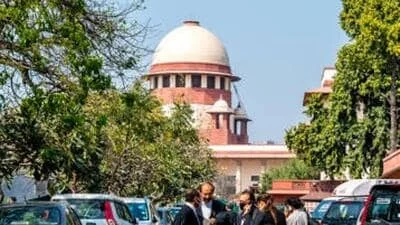
The Supreme Court on Thursday, by a 5:4 majority, refined the expansive test laid down nearly five decades ago to determine what constitutes an “industry” under the now-repealed Industrial Disputes Act, while unanimously protecting all pending disputes from the impact of the new formulation.
Pending cases, he agreed, could continue to be decided under Bangalore Water Supply. A nine-judge Constitution bench headed by Chief Justice of India Surya Kant also upheld, by a majority, the maintainability of the reference that had brought the 1978 landmark Bangalore Water Supply & Sewerage Board Vs A Rajappa judgment back for reconsideration.
In his judgment, for himself and Justices SC Sharma, Alok Aradhe and Vipul M Pancholi, the CJI held that the test evolved in Bangalore Water Supply required “refinement and reformulation”, but stressed that the exercise was not intended to prejudice cases already pending under the old law. “All matters presently pending under 1947 Act may be adjudicated in terms of the triple test,” the CJI said while pronouncing the operative part. The CJI also said that the court was refraining from commenting on the definition of “industry” under the new law. The previous interpretation, he made clear, could not be treated as a “sheet-anchor” for interpreting the definition under the new Code. At the same time, he noted that the determination of “industry” had effectively become redundant with the repeal of the old law and its replacement by the Industrial Relations Code. Justice Narasimha also agreed that the definition of “industry” under Section 2(p) of the new Code could not be burdened with the interpretation placed on Section 2(j) of the repealed Industrial Disputes Act. Justice BV Nagarathna, writing for herself, said the reference itself was unnecessary and that the previous judgments could have been reconciled with Bangalore Water Supply. She held that the expansive definition of “industry” was imperative and that the triple test remained correct.
Key Legal Questions Surrounding Industrial Definition
A nine-judge bench is currently reviewing critical legal questions stemming from the interpretation of Section 2(j) as established in the Bangalore Water Supply case. This ruling introduced a three-fold test to determine if an activity qualifies as an “industry.” The test emphasizes a structured and cooperative effort between employers and employees, aimed at producing or distributing goods or services to meet human needs.
Among the issues under consideration are whether the established triple test remains valid, the implications of the unnotified Industrial Disputes (Amendment) Act of 1982, and the relevance of the Industrial Relations Code of 2020. The bench is also examining whether social welfare activities by government entities can be classified as industrial activities, and which state functions might be exempt from the provisions of Section 2(j).
