
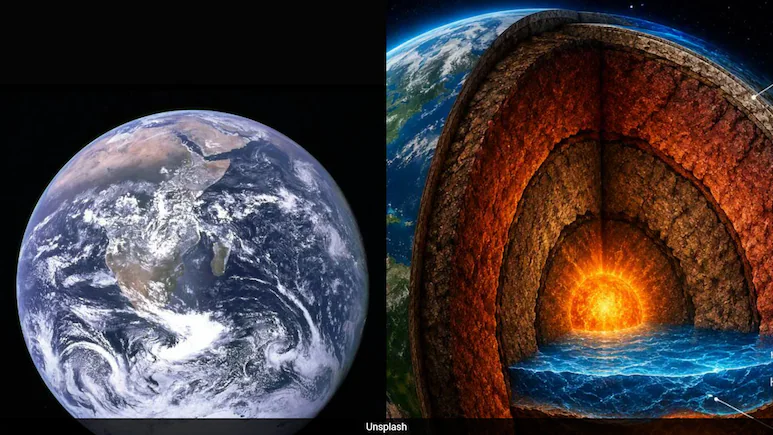
Recent studies have confirmed that water plays a critical role in the movement of the Earth’s mantle, the thick layer beneath the crust. This movement occurs over millions of years and is a key driver of plate tectonics, which significantly influences the planet’s long-term climate. Scientists are investigating where this deep water is stored and its origins. Some theories suggest that asteroids may have delivered water to Earth during its formation, while others propose that a previously dry mantle was hydrated at a later stage.
A new study, published in Nature Geoscience, may have found part of the answer. Most minerals in the lower mantle, such as bridgmanite and ferropericlase, are thought to be dry. So the research team used diamond anvil cells, tiny devices that squeeze samples between diamond tips while lasers heat them, to copy the extreme pressure and heat found deep inside the Earth. He added that many questions remain, including how much water the minerals actually hold and how long it takes for that water to reach the surface. The research is published in Nature Geoscience.
Researchers believe the water sits near the boundary between the lower mantle and the liquid outer core, an area roughly 660 to 2,900 kilometres (373 to 1,802 miles) below the surface.
This region contains strange patches known as “ultralow velocity zones”, which have puzzled scientists for years. Geoscientist Alfred Wilson from the University of Leeds, who wrote a commentary on the study, said the new minerals “represent a breakthrough in the mystery of how the Earth obtained and retained its water.
Remarkably, these minerals formed even when only tiny traces of water were present, less than 0.1 per cent in some tests.
Under these conditions, they discovered two previously unknown minerals, called iron oxyhydroxides, which appear able to store large amounts of water.
