
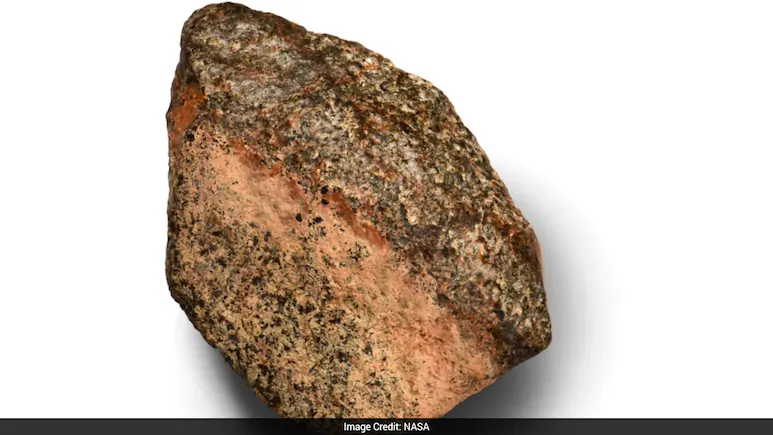
A rose-coloured rock discovered in the Sahara Desert in 2022 has turned out to be a piece of Mars that formed more than 4.1 billion years ago. Scientists studied the minerals in the nearly 800-gram rock and found that it is one of the oldest Martian meteorites ever discovered on Earth, according to NASA .
The study offers a rare look at the ancient crust of Mars and the planet’s early formation. One of the paper’s reviewers described it as a Rosetta Stone for Mars. However, the rock’s unusual textures and minerals caught Liu’s attention. Her team discovered zircon crystals, which preserve information about how rocks formed and help scientists determine their age.
Named Teghaza 001 after the salt plain in Mali where it was found, the meteorite may help scientists understand how the surface of Mars formed and how water interacted with rocks on the planet billions of years ago. Researchers presented their initial study of Teghaza 001 in a paper published in Science on Thursday. Lee Saper, the second author of the study, said Teghaza 001 provides a sample of Martian crust from a region that scientists have not previously studied through a meteorite sample.
Yang Liu, the lead author of the paper from NASA’s Jet Propulsion Laboratory in Southern California, said the meteorite’s unique features became clear only after scientists examined it closely.
The age-dating results surprised Liu. Scientists found that water had altered the meteorite around 4.1 billion years ago, meaning the rock itself had formed even earlier.
