

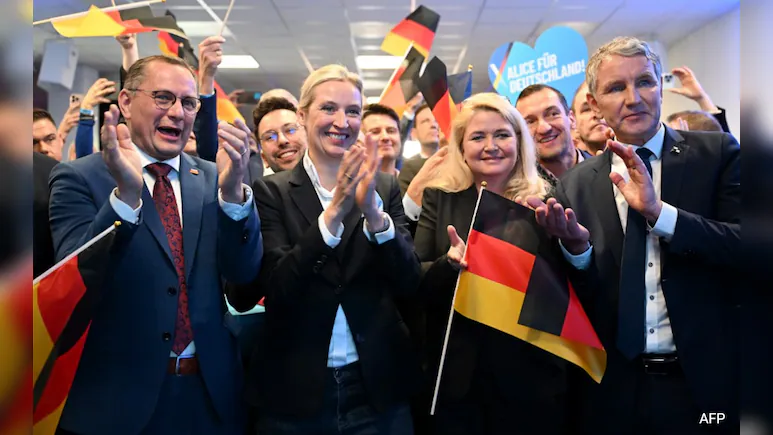
It includes people with neo-Nazi backgrounds; its leaders have downplayed the significance of the Holocaust, which killed six million Jews, and have portrayed minorities as second-class citizens. Because it reminds them of Adolf Hitler’s Nazi Germany, the AfD terrifies many people. The AfD won 43.8% of the vote, more than double its 2021 result, pushing Chancellor Friedrich Merz’s ruling CDU to a distant second position and sending shockwaves across the country and beyond its borders. No party labelled as extreme right in Germany has secured such a big victory in a state election since 1945.
Three years after Germany’s intelligence agency declared the Alternative for Germany (AfD) a “confirmed right-wing extremist” for its “numerous anti-Muslim, racist and antisemitic statements,” voters in Saxony-Anhalt have elected the party by a landslide.
She now faces a challenge from a more far-right party, Futuro Nazionale. Meloni is disliked for supporting Ukraine, the Eurozone, NATO, and the principle of free movement within the EU. In contrast, AfD leaders have spoken in favour of Germany leaving NATO and the Eurozone, and even of exiting the Schengen Agreement. The party not only opposes Ukraine but also seeks closer ties with Russia. In January, Weidel declared that, once in government, the AfD would demand compensation from Ukraine for blowing up the Nord Stream pipeline, which was designed to carry Russian gas across the Baltic to Germany. The far-right German party’s rise and electoral success is not good news for Indians. An estimated three million people of Indian origin live in Europe. Just under two million are in the UK, where the anti-migrant Reform UK has risen rapidly over the past two years, even influencing the current Labour government’s immigration policies. This is hitting Indians. They are not immediately in danger, but the AfD’s victory last Sunday has worried them.
Because she has sought to move towards mainstream European groups, the AfD also considers right-wing Italian leader Giorgia Meloni liberal, despite her neo-fascist roots,. Germany has over three lakh Indians, including about 7,800 in Saxony-Anhalt.
The BSW has won five seats and has said it would help the AfD form a government. An AfD-led Germany may even claim French or Polish territory lost after the Second World War. it could close the gap through possible defections from the CDU or by forming an alliance with the far-left BSW, which shares some of the AfD’s policies Although the AfD is short of three seats to form a government. That prospect, even in one of Germany’s smallest states, would be a major turning point for the country. The fear is that members of the extremist party with neo-Nazi backgrounds might serve in top positions in the state, controlling the police, the domestic spy service (Verfassungsschutz), the judiciary, and education. Even if the party fails to form a government in Saxony-Anhalt, its victory in the state is a major development, as it signals a defeat of Germany’s post-war anti-Nazi and anti-fascist consensus. This was known as a firewall, under which mainstream parties would not work with extremist groups. The AfD also became increasingly extreme. It has exploited growing economic problems and immigration concerns. Several terror incidents involving migrants in the past few years in the country have also helped boost its support. Many people in that part of the country are out of work, and some miss the support they received under communist rule. The rise in energy prices following the Russia-Ukraine war has also been a major factor in public dissatisfaction with the CDU government. The party has exploited this by blaming the government’s support for Ukraine for their financial hardships. The party has offered to resume cheaper gas supplies from Russia if it comes to power. The AfD is not the only far-right political group in Europe, but it is the most radical among those reaching close to power. The rise of these groups in Europe is blamed on mainstream parties’ failure to address the public’s grievances, prompting voters to seek alternatives. All far-right groups in Europe share anti-migrant policies. In France, Marine Le Pen’s National Rally is leading the polls ahead of the presidential elections due next spring. its potential to control such a large economy and military one day will make other European countries nervous Although the AfD is far from coming to power federally in Germany. It may form an alliance with Russia, Austria, Hungary, and other like-minded nations, threatening the security of their neighbours. It may not pose the kind of danger Nazi Germany posed, as the circumstances then and now are different, but it would be a mistake to underestimate the rise of the AfD.
Merz himself reiterated that policy in 2021. In the 2017 federal election, it won 12.6% of the vote, secured 94 seats in the Bundestag (German parliament), and became Germany’s third-largest party. Since then, the party has sought to reframe modern Germany as a continuation of its pre-1933 history, while downplaying the significance of the Hitler era. The AfD has seen a significant rise in eastern Germany, where economic conditions remain worse even after 36 years of German unification.
Its former leader, Alexander Gauland, made an outrageous claim in 2018 that Nazi rule was “mere bird shit in over 1,000 years of successful German history”. But the AfD’s policy of “remigration” targets not just “illegals” but all immigrants (and their descendants) with unwanted foreign backgrounds. Her party split from the AfD in the European Parliament in 2024 when a senior AfD figure declared that someone who had been a member of Nazi Germany’s SS force was “not automatically a criminal”, and a secret plan by the German party emerged for the mass Britain’s late Prime Minister Margaret Thatcher opposed Germany’s reunification, fearing it could again pose a danger to others. A bigger Germany, she warned in 1989, “would undermine the stability of the whole international situation and could endanger our security”.
In last year’s federal elections, the party secured second place and became Germany’s de facto opposition in the Bundestag.
