
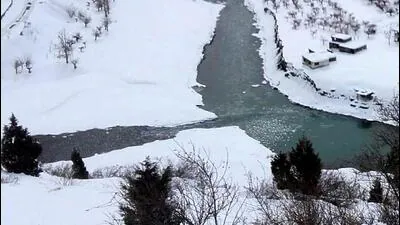
A recent study reveals that glaciers in Uttarakhand’s Central Himalaya are retreating at an alarming average of 23.23 metres per year. Some glaciers are experiencing even more dramatic losses, with ice vanishing at rates of up to 88 metres annually. The research highlights that rising temperatures, along with specific glacier characteristics and local topography, are significant factors influencing this accelerated ice loss.
The study found a marked difference in retreat rates between clean-ice and debris-covered glaciers. Clean-ice glaciers are particularly vulnerable to rapid thermal ablation, or ice loss caused by melting, while those terminating in pro-glacial lakes (lakes formed directly in front of, beside or beneath a retreating glacier) are also exposed to ice loss through calving, when large pieces of ice break off into a lake. In contrast, glaciers covered by thick layers of debris can experience significantly lower melt rates, as the debris acts as a natural insulating shield. The study found that glacier retreat is not uniform and is influenced by a combination of regional climatic changes and local physical characteristics. Another major finding relates to the equilibrium line altitude (ELA), the boundary separating the zone of net snow accumulation from the zone of net melting.
The study found that the average frontal retreat rate across the Central Himalaya was 23.23 metres a year, according to Mehta. Milam Glacier in Pithoragarh district’s Milam valley, for example, has spawned nearly 47 new glacial lakes, according to the study. The study found that the ELA has risen by nearly 500 metres in some regions since the beginning of the century. The study also identified the period around 2000 as an important climatic turning point. The post-2000 period, however, shifted towards a more humid phase, with increasing precipitation trends. The study found that the increased precipitation and snow accumulation after 2000 provided a temporary buffer to some eastern debris-covered glaciers and somewhat slowed their retreat rates.
The study, “Time-dependent assessment of glacier recession in the Indian Central Himalaya”, which is based on observations and satellite imagery from 1990 to 2024, also found that the equilibrium line altitude has risen by nearly 500 metres in some regions since 2000. “Although the response varied substantially between individual glaciers, retreat rates ranged from about 3.7 metres per year for relatively stable or heavily debris-covered glaciers such as Bhagirathi (Bhagirathi valley, Uttarkashi district) and Satopanth (Chamoli district) to as much as 88 metres per year for Khatling Glacier (Bhagirathi valley, Tehri Garhwal), a clean-ice glacier,” he said. Meteorological and reanalysis datasets showed that the late 20th century, particularly 1980-1999, was characterised by a pronounced “warming-drying” trend, with declining precipitation and steadily rising temperatures.
Study Highlights Geology Insights from the Himalayas
A recent study published in Discover Geoscience focuses on geological research in the Himalayan region. Conducted by Manish Mehta from the Wadia Institute of Himalayan Geology in Dehradun, the study also involved contributions from Jyoti Kumari, Girish C Kothyari, and Atul Kumar Patidar, all affiliated with the University of Petroleum and Energy Studies (UPES) in Dehradun. This collaborative effort aims to enhance understanding of the geological processes shaping this significant mountain range.
