
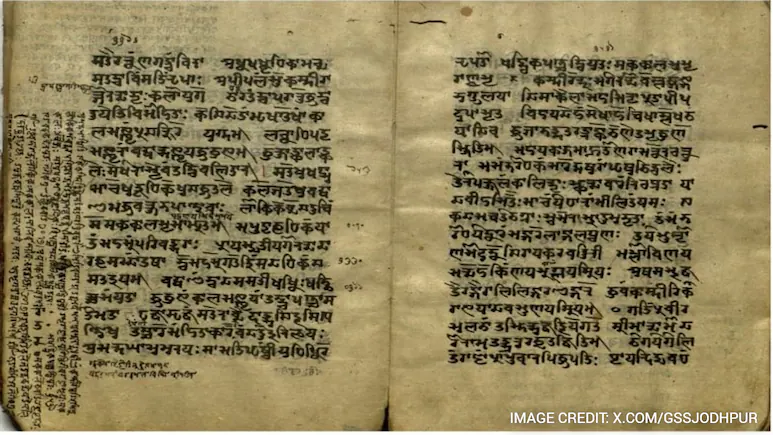
India’s rich documentary and intellectual heritage has received significant international recognition, with three of its most influential historical and literary works, the Mahabharata, Arthasastra, and Rajatarangini, inscribed on UNESCO’s Memory of the World Committee for Asia and the Pacific (MOWCAP) Regional Register.
Union Minister for Culture and Tourism Gajendra Singh Shekhawat welcomed the announcement, describing the inclusion as a moment of immense pride for the country and a landmark recognition of India’s extraordinary documentary and civilisational heritage. The Rajatarangini, composed by the 12th-century Kashmiri historian Kalhana, is widely regarded as one of the most important historical chronicles of medieval India. Written in Sanskrit, it traces the history of Kashmir through successive dynasties, rulers, political developments and social transformations. Its significance lies in its attempt to present historical events through chronological narration, critical examination of sources and literary composition, making it an important resource for understanding Kashmir’s political and cultural past. The Mahabharata, one of the world’s longest epic narratives, occupies a central position in South Asian literary, philosophical and religious traditions. Beyond its account of the conflict between the Kauravas and Pandavas, the epic explores questions of duty, justice, morality, power, kinship and the responsibilities of individuals and rulers. Its philosophical dimensions, particularly the Bhagavad Gita, have influenced generations of thinkers and continue to shape discussions on ethics and human conduct across cultures. The Arthasastra, traditionally attributed to Kautilya, also known as Chanakya, is a foundational work on governance, administration, economics, diplomacy and military strategy. Its detailed examination of statecraft, taxation, law enforcement, intelligence networks and public administration offers valuable insights into political organisation and the functioning of ancient Indian states. The text remains an important reference for scholars studying the history of political and economic thought. It operates through international, regional and national registers. regional registers identify collections and documents that hold particular importance for specific geographical and cultural regions While the International Register recognises documentary heritage of global significance. The Asia-Pacific Regional Register is administered through MOWCAP. It facilitates nominations, promotes archival awareness, supports manuscript conservation and organises capacity-building programmes. At a time when preserving historical records and ensuring access to cultural knowledge have become increasingly important, the recognition underscores the enduring value of India’s intellectual traditions and their place in the shared documentary heritage of the Asia-Pacific region.
The latest inscriptions also highlight India’s growing engagement with UNESCO’s Memory of the World Programme, which was launched in 1992 to protect documentary heritage against loss, deterioration and collective amnesia. India’s participation in the initiative is coordinated by the Indira Gandhi National Centre for the Arts (IGNCA), designated as the country’s nodal institution in 2014.
The programme seeks to ensure that historically and culturally significant documents remain preserved and accessible to future generations.
The three works offer distinct yet complementary perspectives on the intellectual development of the Indian subcontinent. The latest recognition builds on these efforts and reinforces India’s commitment to preserving its documentary heritage. The inclusion of the three works is significant not merely as a national cultural achievement but also as an acknowledgement of their wider relevance to humanity. Together, they demonstrate how historical writing, epic literature and political philosophy have shaped civilisations and transmitted knowledge across generations.
Its contributions to the Asia-Pacific Regional Register include the illustrated Ramacaritamanasa, the Sanskrit poetics text Sahrdayaloka-Locana and a rare 15th-century Panchatantra manuscript, inscribed in 2023. In 2025, IGNCA hosted an international symposium and workshop on UNESCO Memory of the World in South Asia, focusing on regional cooperation, archival conservation and the need to address South Asia’s underrepresentation in global heritage registers.
In a post on X, the minister said the three works represent India’s longstanding traditions of historical inquiry, philosophical thought and statecraft, adding that their wisdom continues to inspire humanity.
India has previously secured international recognition for documentary treasures including the Rigveda, Saiva manuscripts, Tamil medical texts, Kalachakra Tantra commentaries and the works of Abhinavagupta.
