
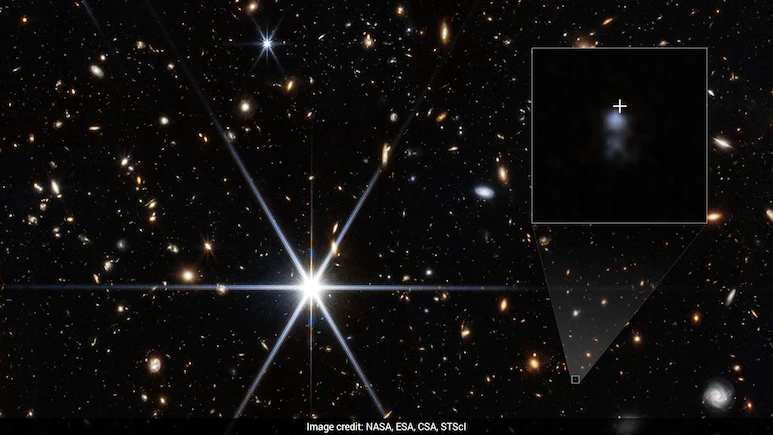
Scientists have been analysing a mysterious flash of energy that was released into the universe a long time ago from a distant galaxy. It travelled for more than 10 billion years to reach Earth, and now, the scientists say that it is the most distant fast radio burst (FRB) ever recorded, according to NASA . First discovered in late 2007, these mysterious flashes have long puzzled researchers, with some early theories even claiming them to be alien technology. A new study, published in the scientific journal Science , reveals that this particular pulse, catalogued as FRB 20240304B, originated when the universe was only around 3 billion years old. Researchers say the wave has travelled across roughly 80% of cosmic history, doubling the previous distance record for any known fast radio burst.
“What makes fast radio bursts interesting is that we don’t know what generates them. She is the lead author on the study. Initial data suggested that the burst came from an extremely distant part of space, but to confirm that distance, the astronomers had to study its host galaxy. They used the James Webb Space Telescope (JWST) to pinpoint the host galaxy. “The host sticks out in the whole galaxy sample that we have. “This combination of using the MeerTRAP project on the MeerKAT telescope to discover and localise these distant bursts and Webb to study their hosts is very exciting. Now, scientists are excited about how these deep-space signals can be used as tools.
We have theories for what objects produce them, but we don’t have conclusive proof,” Manisha Caleb of the University of Sydney said, as quoted by NASA. The flash came from a young, compact galaxy that is actively forming stars at a fast pace and contains very few heavy elements, according to the data. And it definitely was not what we were expecting,” said Ben Stappers of the University of Manchester, United Kingdom, a co-author on the paper.
