
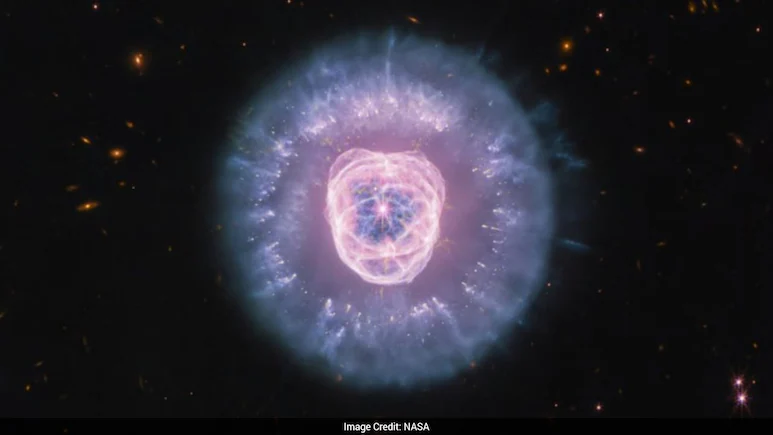
NASA’s James Webb Space Telescope has provided fresh images of the Lion Nebula, also known as NGC 2392. These new observations reveal intricate details about the nebula’s distinctive shape and the dying star located at its center. This enhanced view offers a deeper understanding of the cosmic phenomena occurring within this region of space.
Using its NIRCam (Near Infrared Camera) and MIRI (Mid-Infrared Instrument), Webb has revealed a clearer and more detailed image of the Lion Nebula. Webb’s infrared view more clearly displays small clumps of dust and hazes of ionised gas While its overall structure resembles Hubble’s visible-light image. It has taken thousands of years for the gas and dust to shape the nebula into its current form, and changes are still ongoing in various parts of it. At the centre of the Lion Nebula lie the remnants of a dying star. Unlike massive stars that end their lives in supernova explosions, lower-mass stars conclude their lives differently. When such a star can no longer sustain nuclear reactions in its core, it becomes unstable and begins to pulsate. It then sheds its outer layers, which transform into shells of gas and dust, forming what is known as a planetary nebula. The star’s radiation pushes this material outward, leaving behind an extremely hot core called a white dwarf. In the Lion Nebula, a white dwarf remains following the death of an oxygen-rich central star. This bubble is expanding over time, destroying the dust in its path. Complex rings and shells formed by swept-up gas are commonly observed in planetary nebulae; however, understanding their intricate structures remains an ongoing area of study.
NASA’s Hubble Space Telescope had previously observed the planetary nebula in 2000, showing its lion face-like shape and features such as a hazy “mane” made of comet-shaped objects. It resembles the “button nose” of a lion, yet its energy and radiation drive the complex structures surrounding it. It is “cooking” the surrounding material from within and creating a bubble of ionised gas that forms the appearance of the lion’s face.
