
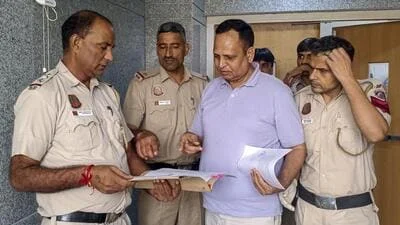
A Delhi court on Thursday granted bail to Aam Aadmi Party (AAP) leader Satyendar Jain in a corruption case dating back to his tenure as Delhi’s water minister, observing that the Anti-Corruption Bureau (ACB) “rushed in to arrest him” without gathering sufficient evidence.
The AAP leader was granted bail on a personal bond of ₹ 2 lakh and two sureties of the like amount. Jain was arrested on August 18 along with five others in a DJB-related corruption case. Five accused, including Jain, were sent to 14 days of judicial custody, while former DJB contractual consultant Ankit Shrivastava was remanded to two days of ACB custody.
In his order, special judge Dig Vinay Singh of Rouse Avenue Court underlined that a few decisions taken by Jain during his tenure as a minister “do raise eyebrows” and that “he may not be innocent”, but the material gathered by ACB so far was “not enough”.
Court to Rule on Accused IAS Officer and Others
The court is set to address the plea of five accused individuals, including Udit Rai, an IAS officer and former CEO of the Delhi Jal Board (DJB), on September 5. This decision will determine the legal standing of all involved parties in the case.
Court Critiques Delayed Arrest in Ongoing Investigation
A recent court order has criticized the investigating agency for its handling of a case involving Jain, highlighting a significant 27-month delay between the filing of the FIR and his arrest. The court emphasized that the agency should have conducted a more comprehensive investigation and gathered additional evidence before proceeding with the arrest.
The judge pointed out that the prosecution failed to present any new circumstances that justified Jain’s arrest after such a lengthy period. The order noted that little progress seemed to have been made in the investigation during this time, apart from collecting documents and responses.
Additionally, the court remarked on the arbitrary nature of a sudden arrest after years of investigation, especially when the accused has cooperated throughout the process. It ruled that Jain posed no flight risk and was unlikely to influence any witnesses. The court concluded that continued detention could not be justified based on a vague assertion that a conspiracy remained undiscovered.
