
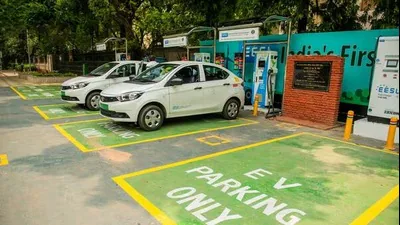
Delhi topped India’s states and Union territories in the India Electric Mobility Index (IEMI) 2025, scoring 84, according to the index released by NITI Aayog on Wednesday. Maharashtra ranked second with 78, followed by Karnataka (73), Chandigarh (71) and Goa (65).
Among hilly and northeastern states, Manipur ranked highest with a score of 46.
The index was launched in Delhi as part of a NITI Aayog workshop on state electric vehicle (EV) policies. Delhi seeks unused ECC funds for EV subsidies Delhi has sought the Supreme Court’s permission to utilise unused environmental compensation charge (ECC) funds to finance electric mobility measures under its new EV policy, Delhi transport secretary-cum-commissioner Niharika Rai said on Wednesday. “This improvement reflects substantial progress across multiple indicators, including policy, charging infrastructure and ecosystem development. It also noted that Delhi was the first state to provide subsidies for electric cycles. We’re behind only China in EV two wheelers, but they have low speed two-wheelers, so our two-wheelers are the most technologically advanced.
IEMI 2025 is the second edition of the index, prepared by WRI India in collaboration with NITI Aayog. It measures the progress of states and UTs towards an electric mobility transition, based on data from January to December 2025. He said India’s dependence on imports for nearly 89% of its crude oil requirements was likely to increase as car ownership rises unless EV adoption expands. Gauba also noted that the automotive sector contributes around 7.1% of GDP and supports nearly 19 million jobs, underscoring the importance of keeping the sector aligned with the global transition to EVs. The index showed that 29 of India’s 36 states and UTs have now notified EV policies. Overall scores also improved compared with the first IEMI, with the highest score rising from 77 to 84 and the median score increasing from 36 to 40. Madhya Pradesh recorded the biggest improvement, climbing 16 positions from 23rd, with a score of 31, to seventh with a score of 59. Other notable gainers include Goa, which climbed 10 positions to fifth (65); Puducherry, which also advanced 10 places to 17th (41); Bihar, which rose eight positions to 18th (40); Jammu & Kashmir, which rose seven places to 27th (31); and Assam, which moved up three places to 24th (35),” said the report. It also noted that under Delhi’s new EV Policy 2.0, the Capital is the first state or UT to mandate 100% electrification of autorickshaws and light commercial vehicles from January 2027, and of two-wheelers from January 2028. As of February 2026, Delhi was operating 4,286 electric buses, the largest electric-bus fleet in India, the report said. “India sold 2.1 crore two wheelers last year, out of which 14 lakhs were EV two wheelers, which is around 7.65% of the total. Speaking at the NITI Aayog workshop, Rai said Delhi’s EV Policy 2.0 had earmarked ₹ 4,000 crore in subsidies and incentives over four years, and the transport department was seeking access to a substantial portion of the unused ECC funds. HT reported on September 16 that 60%, or more than ₹ 1,153 crore, of ECC collected in Delhi was lying unutilised. “We require over 1,000 crores per year as per the new EV policy, so we have written to the SC, through the state environment department to access these funds for EVs. Over 1,000 crores is lying unused.
Launching the index, NITI Aayog member Rajiv Gauba said the shift to EVs was “an economic, environmental, and strategic imperative” for the Viksit Bharat 2047 vision. Hanif Qureshi, additional secretary, ministry of heavy industries, said state policies must complement the Centre’s measures to incentivise EV adoption. In three wheelers, we are number one and in EV cars, we have the third largest market in the world,” he said. If approved, this will help secure funds, in addition to what the state will provide,” Rai said.
