
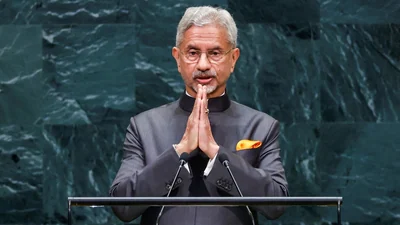
External affairs minister S Jaishankar on Saturday told the UN General Assembly that the world was witnessing “a weaponisation of everything”. He said finance, market access, supply chains and technology were being used as leverage, and that developing nations were caught in a crisis of food, fuel, fertiliser and finance – with a looming El Nino expected to exacerbate this crisis.
“Instead, what we are actually seeing is a weaponisation of everything…
Addressing the general debate of the Assembly’s 81st session in New York, Jaishankar said strengthening stability, security and predictability was imperative for peace, and warned that the world was “living on the edge of an abyss” under continuous threats and pressures. “All it takes is one more step to push us over,” he said. After eight decades of the UN, strengthening them “should have become our second nature”, he said. Resources and connectivity had become “particularly subject to leveraging”, pushing nations to focus on de-risking and diversifying, he said, without naming any country. “While this may secure their interest to varying degrees, the overall atmosphere is no longer that of trust or goodwill.”
He urged all parties to exercise restraint, de-escalate, and ensure the protection of civilians and the uninterrupted flow of energy and commerce. India supports ongoing initiatives to bring peace. Even as this is underway, there is an urgent need to address the security of seafarers and supply of food grains and energy. India is prepared to do everything possible to ameliorate this situation, especially with regard to food and energy security.
India, he said, had joined Liberia and 23 other partners in an initiative to rally global public opinion against such targeting. At least 15 Indian seafarers have been killed in West Asia and the Black Sea this year, according to government figures.
On the conflict in the Gulf, which he said was “exacerbating an already difficult situation”, Jaishankar called the targeting of commercial shipping and seafarers in international waterways “simply unacceptable”. Attacks on shipping had spread “from the Red Sea to the Black Sea”, he said, and Indian seafarers had lost their lives along with those of other nations. On the war in Ukraine, now in its fifth year, Jaishankar said: “As Prime Minister Narendra Modi stated, endless war must give way now to an end to war.
US ambassador to the UN Mike Waltz acknowledged India’s efforts to secure energy and food supplies during a UN Security Council debate on Ukraine earlier in the week.
The minister reserved his sharpest words for Pakistan, without naming it. “That will not stand. “Friendship and goodwill cannot coexist with terrorism. And understandings premised on that will naturally be called into question. He also cited the progress of the International Solar Alliance, the Coalition for Disaster Resilient Infrastructure and the Global Biofuels Alliance, and India’s role as a first responder after disasters, including the recent flash floods in Nepal.
Setting out India’s own contribution, Jaishankar cited 600 major development projects in 78 nations, spanning infrastructure, manufacturing, agriculture, IT and capacity building.
The predicament of the Global South was “particularly acute”, Jaishankar said, describing a “4F crisis” of food, fuel, fertiliser and finance. “The combined impact of a super El Niño, compounding fertiliser shortages and now impediments to grain movements, all these are cause for alarm,” he said, adding that progress on the Sustainable Development Goals was under increasing pressure. A “serial practitioner of terrorism” had “misrepresented facts” before the Assembly the previous day, he said, invoking arguments “to normalise terrorism and claim immunity from its consequences”. Our right to defend ourselves against terrorism will be exercised,” Jaishankar said. It is for the perpetrator of terrorism to mend its ways,” he said. State-sponsored, cross-border terrorism was “a direct affront to the global order”, he said, calling for governments indulging in it to be held accountable and for terror financing to be exposed and countered. He said the misuse of artificial intelligence was “sharpening bias and diluting mutual respect”. Pointing to the AI Impact Summit India hosted in February, he argued for “the right of each nation to shape its ecosystem with the development of its own models and deployment strategies consistent with its national goals and priorities”, and said AI would be part of India’s partnership agenda with the Global South.
