
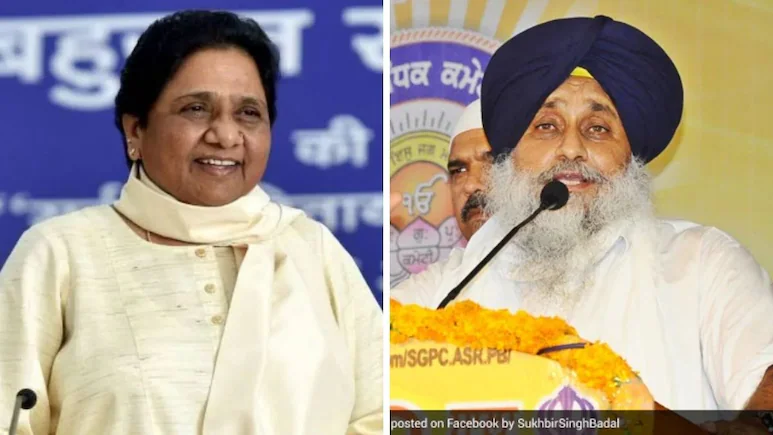
It’s a double whammy for the troubled Shiromani Akali Dal (SAD). First, the BJP declined a poll alliance; now the Bahujan Samaj Party (BSP) has also decided to part ways and go solo in the Punjab battle.
The BSP supremo last week held a review meeting with senior party office-bearers from Punjab at the BSP Central Camp Office in Lucknow to discuss strategies to expand the party’s voter base in the state. “BSP’s vote share shows that it is no more a big player. The BJP leadership may have avoided a poll alliance at this juncture but talks were on. However, no party in Punjab can polarise Dalit votes as they remain a scattered political force. The BSP has remained a persistent but limited player. There are Mazhabi Sikhs and Balmikis who form one cluster; Ravidassias, Ramdasias and Ad-Dharmis form another. BSP’s decline followed three constraints: First, Punjab’s Dalits are not one voting group. Different sub-castes back different parties, and Congress, SAD and others have long split that vote. Second, after Kanshi Ram, the BSP never built a strong Punjab leadership of its own. Lucknow ran the party. Able local leaders left for Congress, SAD and AAP. Third, bigger parties took away BSP’s support base by offering welfare, putting up Dalit candidates, and working through deras.
So, will the Shiromani Akali Dal stand to lose Dalit votes as BSP goes solo in 2027? Analysts say ‘not much’, as BSP’s current vote share is just 1.77 per cent, but the party can impact SAD’s Dalit vote share in the Doaba region to some extent. For Shiromani Akali Dal, partnering with BJP was a better choice as its vote share is nearly 19 per cent. “Punjab has India’s highest Scheduled Caste share – 31.94 per cent – yet that number has never become a stable BSP vote.
She made it clear that, much like in Uttar Pradesh and Uttarakhand, the BSP will contest elections in Punjab entirely “on its own strength” without entering into an electoral alliance with any other party. She stated that past alliances had caused the party losses both in terms of seats and vote percentage, which ultimately “lowers the morale of party workers”. The final decision, as the state leaders say, will be taken by the party high command,” says Prof Gurmeet Singh. The party took root among the latter group in Doaba, not among Dalits as a whole,” says senior journalist Rajinder Jadon.
Large sections have historically aligned with the Congress, while others have supported the SAD or, more recently, the Aam Aadmi Party.
