
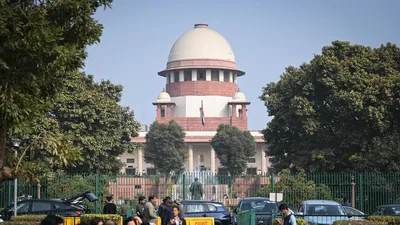
On Wednesday, the Supreme Court referred petitions that challenge the law governing the appointment of the Chief Election Commissioner (CEC) and Election Commissioners (ECs) to a five-judge Constitution Bench. This decision marks a significant step in addressing the legal framework surrounding the election commission’s leadership appointments.
A bench of justices Dipankar Datta and Satish Chandra Sharma was dealing with petitions challenging the constitutional validity of a law – Election Commissioners (Appointment) Act – excluding the Chief Justice of India (CJI) from the high-level committee for appointment of chief election commissioner (CEC) and election commissioners (ECs). The petitions filed by Association for Democratic Reforms (ADR) and Congress leader Jaya Thakur among others challenge the validity of the CEC and other ECs (Appointment, Conditions of Service and Term of Office) Act, 2023.
The Act which excludes CJI from the selection panel fails to preserve free and fair elections which form part of the basic structure of the Constitution, according to them. The petitioners also claimed the law threatens the independence of the Election Commission of India (ECI) by allowing the government to appoint their “yes man”.
In these two appointments too, the CJI is part of the selection committee. But even then, the court acknowledged the rights of Parliament. Under Article 324(5) of the Constitution, Parliament can bring a law to govern the conditions of service of election commissioners. The 2023 judgment noted that such a law governing appointment of CEC/ECs was not brought since Independence and went on to issue directions by forming a selection committee, on the lines of selection of the Director of the Central Bureau of Investigation and the Chief Vigilance Commissioner.
During the earlier arguments in the case, Attorney General R Venkataramani along with solicitor general Tushar Mehta said that since “substantial questions of law” relating to interpretation of Constitution arise for consideration in this case, Article 145(3) of the Constitution requires the matter to be heard by a bench with minimum strength of five judges.
