
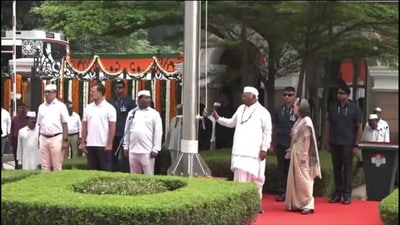
Sumitro Chatterjee, a BJP MLA and direct descendant of Bankim Chandra Chattopadhyay , has sought an unconditional apology from Congress Parliamentary Party chairperson Sonia Gandhi over an alleged incident during the party’s Independence Day event at the AICC headquarters on August 15.
BJP MLA Expresses Discontent in Letter to Gandhi
The BJP MLA from Naihati has reached out to Gandhi in a letter, identifying himself as a concerned citizen and a direct descendant of Bankim Chandra. He conveyed his feelings of ‘deep pain, emptiness, and anger’ regarding recent events.
Gandhi and Kharge can subsequently be seen allegedly gesturing to stop the song. He added that the song was a national symbol earned through the sacrifices of freedom fighters and that respecting it was equivalent to respecting the country’s freedom struggle.
A video from the Congress event shows Gandhi speaking to party president Mallikarjun Kharge while “ Vande Mataram ” is being played. The Congress, however, denied that there was any attempt to stop the singing of the full version of “Vande Mataram”. The party said Gandhi was only asking for a chair for Kharge. Invoking Sri Aurobindo’s description of “Vande Mataram” as a mantra that initiated the nation into the “religion of patriotism”, Chatterjee said any reluctance to recite the full song on the soil of free India was an insult to the sacrifices of freedom fighters such as Khudiram Bose. The BJP MLA alleged that the Congress’s “so-called dual policy” towards the song was not new. He referred to the party’s decision in 1937 to truncate “Vande Mataram” after objections from Mohammad Ali Jinnah, saying the shadow of that “compromise” was visible again in the party’s conduct. Chatterjee also pointed to the Congress’s West Bengal student wing, Chhatra Parishad, which uses the slogan “Mantra moder sanjeevan – Vande Mataram”, and questioned why the party’s top leadership would be uncomfortable with the song. He said “Vande Mataram” was not the property of any political party but part of India’s collective memory and Bankim Chandra’s legacy.
