
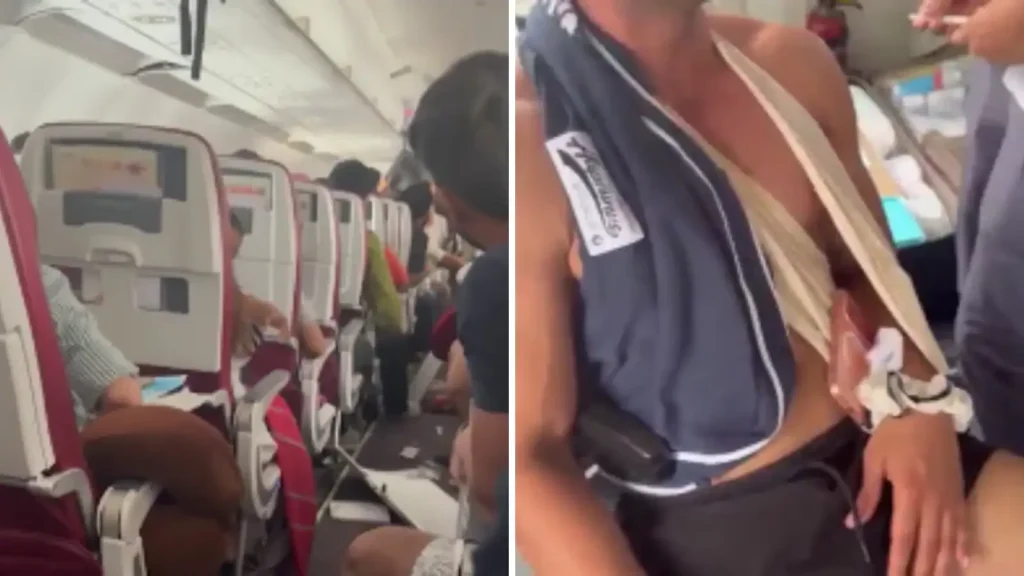
An internal Air India Flight Safety report, accessed by NDTV, gives details of the chaotic few seconds on board when the co-pilot at the controls of the Airbus A320 was forced to push the aircraft into a sharp nose-down attitude to quickly gain airspeed and prevent the jet from stalling.
What Happened
Air India’s outgoing CEO Campbell Wilson met senior officials from the Ministry of Civil Aviation on Tuesday and minister Ram Mohan Naidu said the incident is being taken very seriously. Speaking exclusively to NDTV’s Shiv Aroor on Tuesday, hours after sources said that the captain of the plane had failed two dope tests and had smoked marijuana, the passenger, who requested that his name not be revealed, also questioned why the pilot did not make an emergency landing to ensure the injured could get immediate medical attention. “We wanted to get a direct update from Air India also on the incident and we wanted to see how they are approaching the issue. There shouldn’t be any compromise from any side – the regulator, airlines or anyone else. I was made fun of. There were memes and everything. People asked how I thought he could fly when high,” he recalled. Emergency Landing “For the first time in my life, I saw a pilot come out of the cockpit and then coach the passengers not to record or not do this or that. His clear statement, which has been recorded in videos as well, was ‘baat ka batangad ban jayega’ . We were in a life-and-death situation; who is so worried about being recorded? His major concern was not how he could ensure medical treatment for everyone. His thing was to land in Delhi, so he didn’t have to answer any questions or anything like that. So he did not make any emergency landing anywhere else,” the passenger alleged.
The Directorate General of Civil Aviation (DGCA) has classified the event as a serious incident, and the Aircraft Accident Investigation Bureau (AAIB) is investigating under the International Civil Aviation Organisation’s Annex 13 framework, with technical assistance from Airbus and France’s BEA. At least 13 passengers and four crew members suffered injuries in the incident.
In a statement, the Ministry of Civil Aviation said the Aircraft Accident Investigation Bureau (AAIB) has begun investigating the incident. I have said time and again that safety in aviation is the ministry’s topmost priority. This issue has been taken very seriously by the ministry as well,” he said. Levelling serious allegations against the captain of the Phuket-Delhi flight which lost altitude and plummeted 300 feet last week, a passenger who was on the plane said the pilot was visibly high before the plane took off and, after the incident, asked passengers not to record anything, saying ” baat ka batangad ban jayega ” (it would be making a mountain out of a molehill). “After the first test, which the pilot failed, I called my brother and told him (we were right). When we were leaving the airport, a media person asked us about the incident, and I said the pilot appeared to be high.
People Involved
An amber caution on the Engine Warning Display later confirmed the jet had exceeded its -1g structural limit during the event. The ‘Flight Safety Department: Inflight Upset Stall Warning Event’ states that the captain of the flight was standing behind the first officer’s seat discussing the aircraft’s air conditioning system when aural and ECAM (Electronic Centralised Aircraft Monitor) alerts erupted together, warning that the aircraft was stalling. The autopilot disengaged and the nose pitched up. The first officer, who was flying at the time, responded with a trained stall-recovery response – pushing the nose down. The captain, still out of his seat at this stage, described watching the first officer and every loose object in the cockpit, including himself, float upward as the aircraft briefly went weightless. Following manufacturer guidance, the crew ran the associated checklists, cross-checked system pressure pages, found all parameters normal, and judged the caution signs as being potentially spurious. A separate ‘transient hydraulic caution’ was cleared via the aircraft’s reset procedure.
The report indicates that a “door arm forward emergency” caution appeared on the ECAM and reappeared twice more. The crew said all actions followed standard operating procedures and normal cockpit task-sharing.
Investigation and Response
“The sole objective of the investigation is to determine the circumstances and contributing factors relating to the occurrence and to identify appropriate safety measures to prevent recurrence. The investigation is independent, evidence-based and comprehensive, and no inference regarding the cause of the occurrence should be drawn from any isolated piece of information while the investigation is in progress,” it added.
