
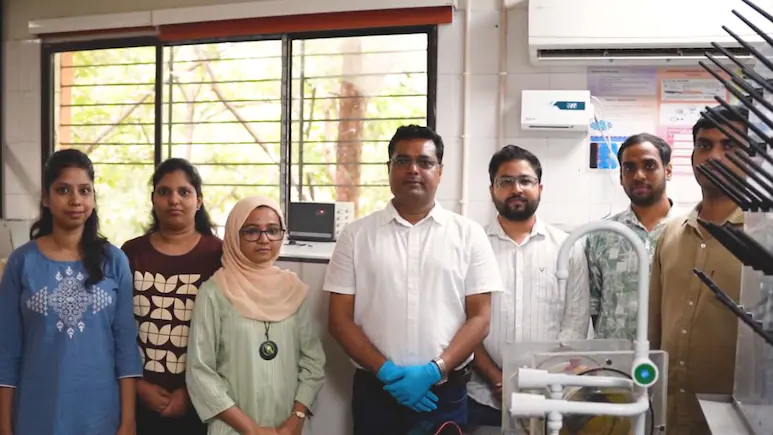
IIT (ISM) Dhanbad: The Indian Institute of Technology (Indian School of Mines), Dhanbad, has secured an Indian patent for an environmentally focused innovation, an electrochemical reactor that recovers copper from wastewater. The licence was granted by the Patent Office, Government of India, to Prof Vipin Kumar, Department of Environmental Science and Engineering, IIT (ISM) Dhanbad, along with his PhD scholars Nishant Pandey and Ankur Singh.

The reactor uses an electrochemical process to extract and recover copper from wastewater streams, enabling resource recovery, that is, copper, a high-demand metal, is retrieved instead of being lost in effluents. The institute has highlighted the technology’s potential for mining and allied industries. In a social media post on X, the institute stated: “The invention promotes resource recovery, circular economy principles, and environmentally responsible wastewater management, with significant potential for applications in mining and allied industries. Stressing on environmentally responsible management, the institute stated that reduced metal discharge lowers toxicity risks to water bodies and ecosystems. Explaining the process, the institute noted that the technology uses a cathodic electrochemical process. As the wastewater is treated, copper particles get deposited on the electrode and are recovered, causing less pollution while claiming the valuable material, the official announcement highlighted. The breakthrough is particularly significant for mining and metallurgical industries, where copper-heavy wastewater is a major environmental challenge, the institute added.
Kumar has over 100 published research papers and recognitions, including the Inder Mohan Thapar Foundation Research Award, as per the official information.
The granted patent covers an invention titled “An Electrochemical Reactor for Cathodic Recovery of Copper from Wastewater, according to official information. “This achievement reflects IIT (ISM) Dhanbad’s continued commitment to impactful research, technological innovation, and the development of sustainable solutions addressing global environmental challenges,” it added. “It offers a real sustainable solution for wastewater management in mining-affected regions,” the institute said. Kumar’s research focuses on environmental microbiology, microbial electrochemical systems, and waste management, according to official records.
