
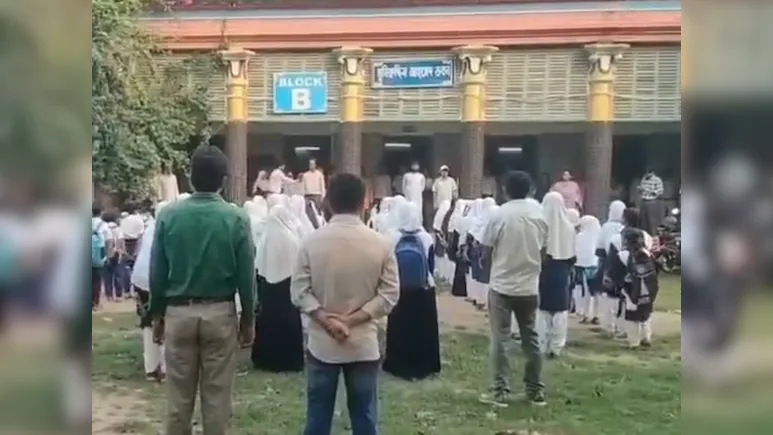
Islampur in Uttar Dinajpur and Haripal in Hooghly: These are two recent examples of what are being described as illegal madrasas in West Bengal. Reports suggest that no classes are held there, no functioning school, and no teachers. In Haripal, one such madrasa has virtually turned into a large banana plantation. In Islampur, government permission for the structure was reportedly granted several years ago, but the building now stands like an abandoned house. Who comes there, why they come and what actually happens inside remains unknown.
Even today, this happens in Kashmir. The Islamic factor had always been an important consideration. There is, however, another important aspect to the madrasa debate: The original purpose of madrasas was different. In Arabic, the word ‘madrasa’ means a place of study. Education was to be provided free of cost, along with food and shelter. This kind of religious education was once also part of Hindu household culture. In the 19th Century, during the time of Raja Rammohan Roy and Ishwar Chandra Vidyasagar, the Upanishads and the Gita were studied and discussed in homes. That tradition has largely disappeared. The Vedas and Upanishads are no longer commonly taught in homes in the way they once were. After the Bombay blasts, which were associated with Dawood Ibrahim and others, surveillance by the Intelligence Bureau increased significantly. There is concern that from Bengal, terrorists could gradually spread into other parts of the country. The BJP’s central leadership is also seeking a consensus on the issue in the Assembly. The proposal is that an all-party resolution should be brought forward with a clear message: We are against terror. The BJP’s central leadership also believes that greater precautionary measures are now necessary in relation to madrasas, particularly those located in sensitive border areas.
Because of its geographical location and the lack of fencing along parts of the border, attention then shifted towards the eastern coastal region, and naturally Bengal became a very important area. The first idea, associated with Prophet Muhammad in 610 AD, was that people should be taught the Quran for religious purposes.
Earlier, the western coastal region had been an area of ISI activity.
He also identified four Muslim-dominated districts in Assam. Firoz Shah Tughlaq later expanded the system further. In Bengal, there are three categories of madrasas. One category consists of government-aided institutions, where the government provides support and pays teachers. The third category comprises private, unregistered madrasas, which operate on donations. The number has now increased further. It is now being contended that the unregistered institutions need to be identified and reviewed. Subhendu Adhikari’s move has already sparked strong reaction from Muslim organisations. Toha Siddiqui of Furfura Sharif has described the move as anti-Muslim. The concern also extends to the eastern sector, where terrorists are alleged to be using Bangladesh as a base or route.
Because the legislation made it difficult to identify infiltrators, on basis of the report, the party decided that the IMDT Act should be repealed. In it, he described how Bangladeshi infiltrators had entered Assam after 1971 and how a section of them was becoming involved in militant activities. The Muslim population had grown by 77.42 per cent after 1971, while the Hindu population had increased by 41.89 per cent, according to the figures cited in the report. In 1998, at a national executive meeting in Bangalore, the BJP distributed copies of Sinha’s report among the members. The first madrasa in Delhi was established in 1191, during the period of Muizuddin Ghori. There are around 614 to 628 such madrasas. The second category consists of around 601 registered but unaided madrasas. There are approximately 11,000 such madrasas, according to an intelligence report. Among these are several Deobandi groups, which run around 750 madrasas.
Analysis: Revisiting Bengal’s Madrasas: Suvendu Adhikari Is Doing What CPM Once Wanted
Now Chief Minister Subhendu Adhikari has ordered that the madrasas operating in Bengal be reviewed and that those which are illegal be identified. The exercise will look at which institutions are legal and which are not, what is being taught there and what activities are taking place. Following an intelligence report, Union Home Minister Amit Shah has raised concern, particularly about madrasas in border districts. The allegation is that Bangladesh is being used as a route for Pakistani militants to enter Bengal and the border areas are being used for training. The concern, now, is that religious institutions may be used as a cover for terrorist activities. This, though, is not a new issue. When Buddhadeb Bhattacharjee was Chief Minister, he too had acknowledged that such a problem existed in West Bengal. This led to strong protests from Jamaat, including rallies and demonstrations, and there was considerable reaction within the CPM. What Buddhadeb Bhattacharjee had thought about but could not ultimately carry through, and what Advani had also spoken about, is now something Subhendu Adhikari appears determined to implement. For all these years, the issue remained largely untouched by Mamata Banerjee. During her fifteen years in power, she never made it a major political issue. He, however, could not eventually complete the exercise.
Because the party did not want to confront an issue that had direct connection with votes, bhattacharjee eventually had to distance himself somewhat from the anti-madrasa campaign. Because some had become breeding grounds for terrorism, there, Advani reportedly told Bhattacharjee that madrasas in West Bengal needed to be identified. In 2002 and 2003, Buddhadeb Bhattacharjee became particularly active in taking action against illegal madrasas. On March 6, 2003, there was a breakfast meeting between LK Advani and Buddhadeb Bhattacharjee. At the time, there were suspicions surrounding 408 of approximately 500 madrasas, and Bhattacharjee had agreed to a review. On November 8, 1998, Lieutenant General SK Sinha – who was the Governor of Assam from 1997 to 2003 and had earlier served as Vice Chief of Army Staff – submitted a 42-page report to then President KR Narayanan and Home Minister LK Advani.
Standing in the West Bengal Assembly, he had said a section of madrasas in the border districts had become a breeding ground for terrorism.
